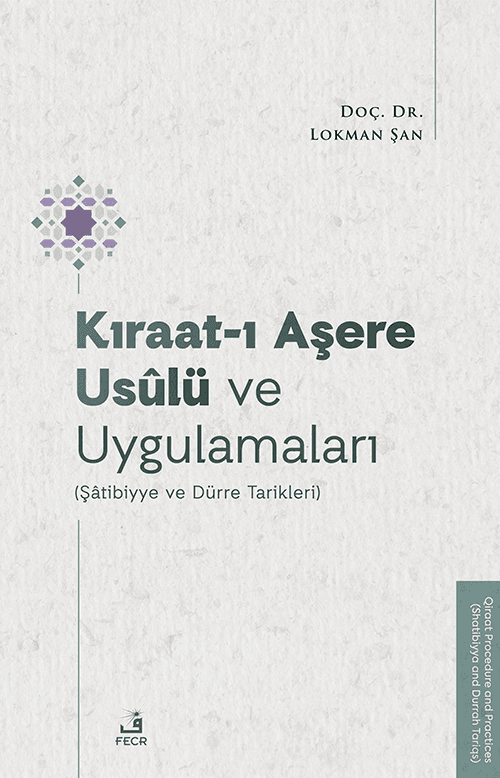
Qiraat Procedure and Practices (Shatibiyya and Durrah Tariqs)
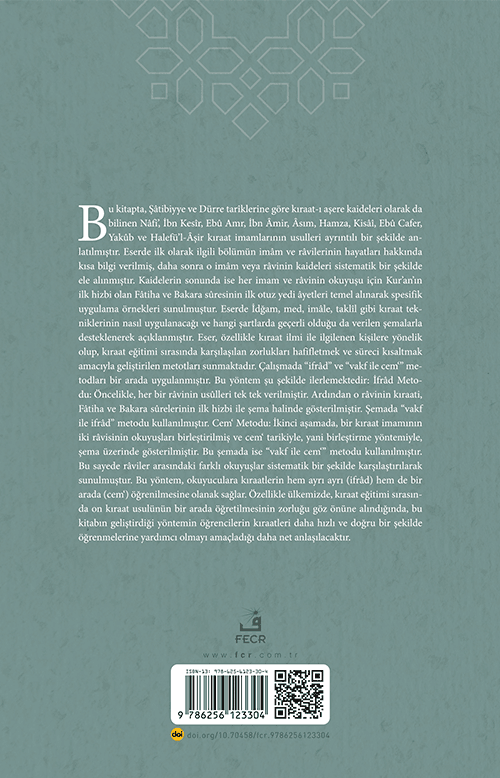
In this book, the methods of the imams of qiraat of Nafi‘, Ibn Kathir, Abu Amr, Ibn Amir, Asim, Hamza, Kisâî, Abu Ja‘far, Yaqûb and Khalaf al-Ashir, also known as the rules of qiraat according to the Shatibiyya and Durrahtariqs, are explained in detail. In the work, firstly, brief information about the lives of the imams and narrators of the relevant department was given, and then the rules of that imam or narrator were systematically discussed. At the end of the precepts, specific examples of practice are presented for the qiraat of each imam and narrator based on the first thirty-seven verses of Surah al-Fatiha and al-Baqarah, which is the first faction of the Qur’an. In the work, how to apply qiraat techniques such as Idgham, med, imâle, and taqlîl and under what conditions they are valid are explained with the support of the given diagrams. The work is especially aimed at people who are interested in the science of qiraat and presents the methods developed to alleviate the difficulties encountered during qiraat education and to shorten the process. In the study, “ifrâd” and “waqf and cem‘”. In the study, “ifrâd” and “waqf and cem‘” methods were applied together. This method proceeds as follows: Ifrâd Method: First of all, the procedures of each narrator are given one by one. Then, the qiraat of that narrator was shown in a diagram with the first faction of the Surahs of Fatiha and Baqarah. In the scheme, the method of “waqf and ifrâd” was used. Cem’ Metodu: In the second stage, the qiraats of two narrators of a qiraat imam were combined and shown on the diagram with the cem‘ tariq, that is, the method of combination. In this scheme, the method of “waqf and cem‘” was used. In this way, the different readings between the narrators were systematically compared and presented. This method allows readers to learn the kiraats both separately (ifrâd) and together (cem’). Considering the difficulty of teaching ten qiraat methods together during qiraat education, especially in our country, it will be more clearly understood that the method developed by this book aims to help students learn qiraats faster and more accurately.
Keywords: Qiraat; Ifrâd; Indirâj; Shatibiyya; Durrah

 İÇ SAYFALAR