Conceptual Idolatry and Philosophy -An Introduction to the Philosophy of Jean-Luc Marion-
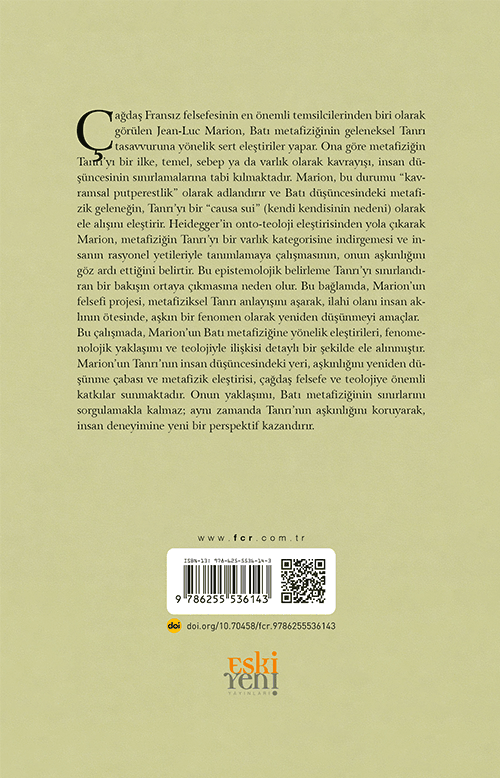
Jean-Luc Marion, regarded as one of the most important representatives of contemporary French philosophy, sharply criticises the traditional conception of God in Western metaphysics. According to him, the metaphysical conception of God as a principle, foundation, cause or being or reason subordinates God to the limitations of human thought. Marion calls this ‘conceptual idolatry’ and criticises the metaphysical tradition in Western thought, which treats God as a ‘causa sui’ (self-cause). Drawing on Heidegger’s critique of onto-theology, Marion argues that metaphysics’ reduction of God to a category of being and its attempt to define God in terms of human rational faculties ignores His transcendence. This epistemological determination leads to a view that limits God. In this context, Marion’s philosophical project aims to overcome the metaphysical understanding of God and rethink the divine as a transcendent phenomenon beyond human reason. As a way to overcome this understanding, Marion wants to bring phenomenology into play. In Marion’s thought, phenomenology plays a critical role in overcoming metaphysical limits. His concepts such as ‘saturated phenomenon’ and ‘givenness’ are the cornerstones of his phenomenological approach. While saturated phenomena express a form of experience that transcends human comprehension, givenness provides a framework that explains how these phenomena present themselves. Through these concepts, Marion seeks to understand God’s transcendent presence in human experience. In particular, it is at the centre of his thought that he seeks to address God through an iconic gaze. The icon represents a form of relationship in which God reveals himself to human beings, yet retains his transcendence by transcending human understanding. This approach aims to overcome both the traditional conception of God in metaphysics and the limitations of modern theology. Regarding the issue of God, which is also at the centre of modern theology and thought, Marion starts from Descartes. Marion’s criticism of Descartes is directed at one of the cornerstones of the modern metaphysical tradition. Descartes centred God as a rational principle and defined him as the fundamental source of knowledge. Marion argues that Descartes’ conception of God as a “self-cause” reduces the divine to a metaphysical system and undermines its transcendence. This criticism is an extension of Marion’s general criticism of Western metaphysics’ understanding of God. On the other hand, Aquinas’ view of God as a transcendent being is seen by Marion as a more consistent and appropriate approach to the nature of God. Marion also pays special attention to Nietzsche, whom he sees as the central figure in the destruction of the traditional Western thought’s understanding of God, and to his statement that ‘God is dead’. According to Marion, this statement is an important point of departure for the reconsideration of many things in philosophy. Marion also discusses Heidegger, another thinker who attaches importance to the phrase ‘God is dead’, and argues that Heidegger’s accusations against metaphysics are true. However, Heidegger exhibits a double idolatry about God. According to him, this is an indication that Heidegger has not fully overcome the issue. We can say that Marion’s philosophy offers an innovative perspective in both metaphysics and theology. His critique of metaphysics emphasises that God should be thought beyond traditional conceptual frameworks. On the theological plane, Marion argues that treating God as a phenomenon beyond human comprehension will preserve the transcendence of the divine. However, Marion’s emphasis on God’s transcendence has been criticised by some critics for detaching God from human experience. However, Marion responds to these criticisms by defending the idea that God reveals himself in human experience, but carries a transcendence that can never be fully grasped. In this study, Marion’s criticisms of Western metaphysics, his phenomenological approach and his relationship with theology are discussed in detail. Marion’s attempt to rethink the place and transcendence of God in human thought and his critique of metaphysics make important contributions to contemporary philosophy and theology. His approach not only questions the limits of Western metaphysics, but also preserves the transcendence of God and brings a new perspective to human experience.
Keywords: God without Being; Conceptual Idolatry; Phenomenon of Revelation; Death of God; Metaphysics

 İÇ SAYFALAR