The Revision of Logic in 13th-Century Islamic Thought
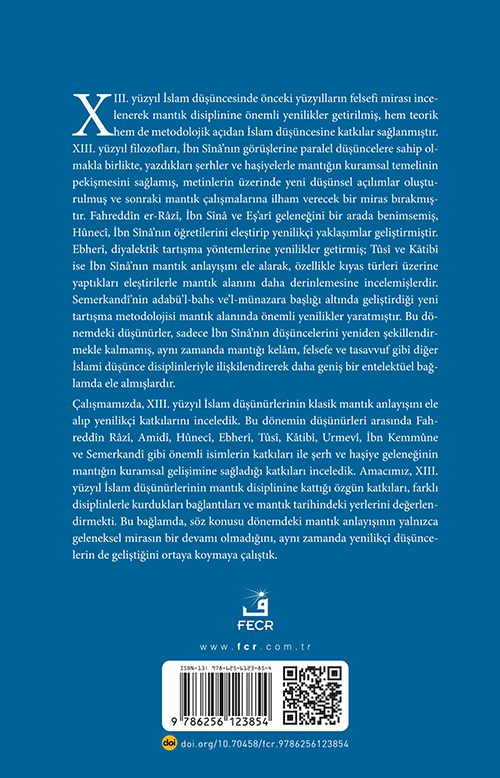
In the 13th century Islamic thought, important innovations were introduced to the discipline of logic by analyzing the philosophical heritage of the previous centuries, and contributions were made to Islamic thought both theoretically and methodologically. Although the philosophers of the 13th century had parallel views to Avicenna’s, their commentaries and glosses reinforced the theoretical foundations of logic, created new intellectual expansions on the texts, and left a legacy that would inspire subsequent logic studies. Fakhr al-Dīn al-Rāzī adopted Avicenna and the Ash’arite tradition together, and al-Khūnajī criticized Avicenna’s teachings and developed innovative approaches. Abharī introduced innovations in dialectical argumentation methods, while al-Ṭūsī and al-Kātibī analyzed Avicenna’s understanding of logic in more depth, especially with their criticisms of syllogisms. Samarqandī’s new discussion methodology, developed under the title of adab al-bahs wa al-munazara, created important innovations in the field of logic. The thinkers of this period not only reshaped Avicenna’s thought, but also placed logic in a broader intellectual context by linking it to other disciplines of Islamic thought such as kalām, philosophy, and mysticism. In our study, we examined the innovative contributions of 13th-century Islamic thinkers to the classical understanding of logic. Among the thinkers of this period, we analyzed the contributions of important names such as Fakhr al-Dīn al-Rāzī, Amidī, al-Khūnajī, al-Abharī, al-Ṭūsī, al-Kātibī, al-Urmawī, Ibn Kammūna, and Samarkandī, as well as the contributions of the commentary and gloss tradition to the theoretical development of logic. Our aim was to evaluate the original contributions of 13th century Islamic thinkers to the discipline of logic, their connections with other disciplines, and their place in the history of logic. In this context, we tried to show that the understanding of logic in this period was not only a continuation of the traditional heritage, but also the development of innovative ideas.
Keywords: Logic; Tasawwur; Tasdīq; Syllogism; Îsâgûjî; Șemsiyya; Ādâb al-bahs wa’l-munâzara; Islamic philosophy; 13th Century Islamic Philosophers

 İÇ SAYFALAR