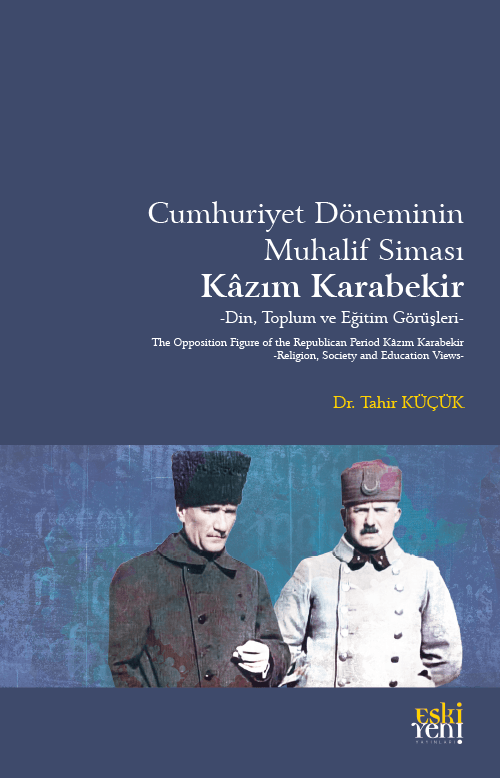
The Opposition Figure of the Republican Period
Kâzım Karabekir
This study examines the position and thoughts of Kâzım Karabekir
Pasha, who made significant contributions to the victory
of the War of Independence and the establishment of the
Republic of Turkey, in certain discussions on religion-state
relations before and after the Republic. Certain difficulties
undoubtedly arose in laying the foundations of the Republic, a
new regime, and in presenting it to the Turkish society. The
traditional and conservative structure of the Turkish society
comes first among these difficulties. Some innovative ideas
that came to the agenda with the Republic caused various
discussions in terms of showing the state authority’s view of
religion. Kâzım Karabekir, who was among the military cadre
that governed the state, opposed Mustafa Kemal Atatürk and
his close circle with his unique thoughts and attitudes both
before and after the Republic. As a result of this opposition,
the official understanding of history sometimes declared Karabekir
persona non grata. He was occasionally accused of being
reactionary and pro-Sharia because he opposed certain secular
views that reflected the state’s view of religion, especially after
the Republic. In this respect, Kâzım Karabekir’s attitude and
stance towards certain developments that can be evaluated
under the heading of religion-state relations has not made
objective evaluations possible due to the official ideology. Karabekir’s
oppositional personality is criticized ideologically by
a certain group, and he is glorified by a certain group for the
same reasons as an alternative personality against the official
understanding of history and Mustafa Kemal Atatürk. In this
respect, Kâzım Karabekir’s thoughts on religion, society and
education are important in terms of reflecting the background
of his oppositional personality. In this direction, the study was
prepared by using the document review method, primarily by
scanning the works written by Kâzım Karabekir, historical and
political documents belonging to that period, memoirs of
people related to the subject, news reflected in the press and
relevant academic literature. When the discussions that took
place during this period are examined, it is understood that
Kâzım Karabekir’s oppositional attitudes did not really stem
from a conservative and reactionary character structure as
claimed. In order to keep the new regime alive due to the
political conjuncture, any criticism and objection was met with
harsh reactions and those who made these criticisms were
labeled as anti-innovation, traditionalist and conservative.
Keywords: Kâzım Karabekir, Religion, Society, Education,
Religion-State Relations, Opposition

 İÇ SAYFALAR