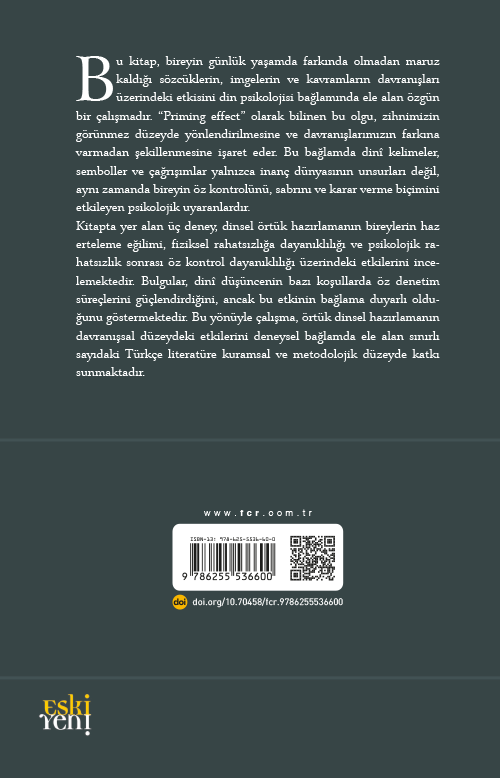
This book explores the relationship between self-control and religion
through an experimental approach in the psychology of religion.
Self-control is conceptualized as the capacity to inhibit impulses, regulate
behavior, and pursue long-term goals. The impact of religious concepts
on this capacity was tested through three separate experiments.
In the first experiment, the effect of implicit activation of religious
concepts on individuals’ preferences for delayed versus immediate rewards
was examined. The second experiment measured tolerance to
physical discomfort using a vinegar-based drink task, revealing that
participants exposed to religious priming showed greater endurance.
The third experiment investigated helping behavior following social
discomfort (donation task) but found no significant effect of religious
priming on prosocial responses. The findings indicate that religious concepts
can enhance self-regulation under specific conditions; however,
the strength of this effect depends on contextual and behavioral factors.
Overall, the results highlight that religious belief and practice contribute
to self-control capacity both cognitively and motivationally. The
study provides an original contribution to the psychology of religion
by combining experimental methods with the investigation of religious
motivation and behavioral regulation.
Keywords: Self-control; Religiosity; Religious implicit priming; Psychology
of religion; Experimental psychology; Self-contol; Will power;
Patience; Delay of gratification; Prosocial behavior; İmplicit priming

 İÇ SAYFALAR