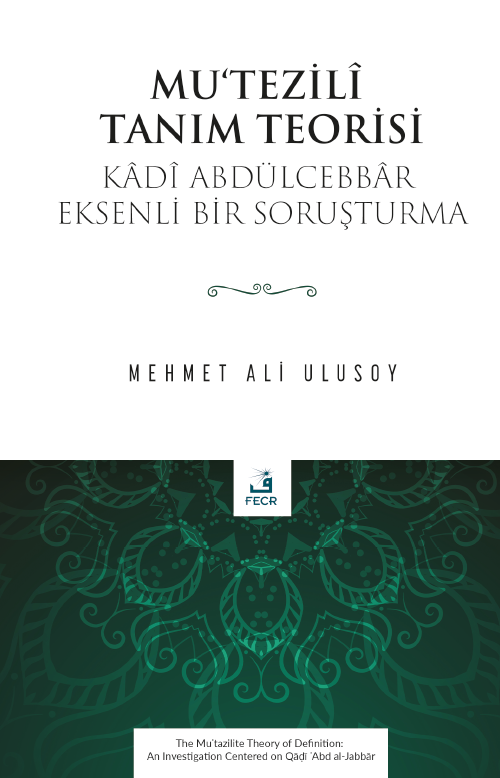
The Muʿtazilite Theory of Definition
An Investigation Centered on Qāḍī ʿAbd al-Jabbār
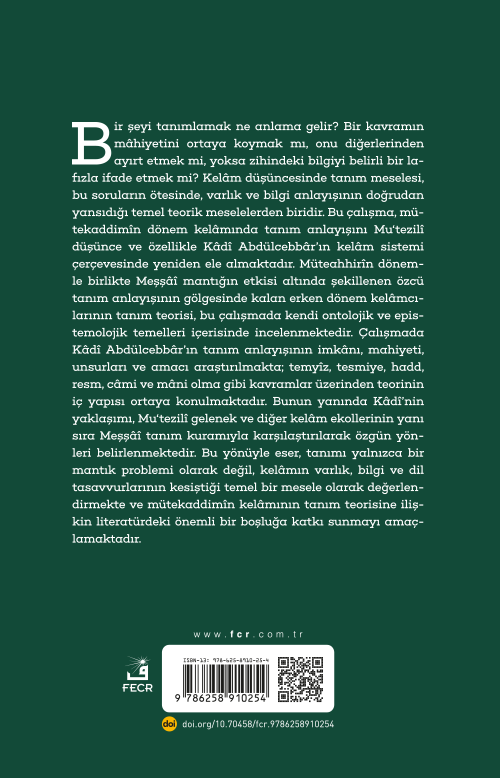
In contrast to the kalām tradition of the later (mutaʾakhkhirūn) period,
which became deeply intertwined with philosophy, the kalām of the
early (mutaqaddimūn) period, particularly Muʿtazilite theology, may
be characterized as a relatively pure form of kalām activity due to
its distance from philosophical influences. In both ontology and epistemology,
Muʿtazilite theologians sought to maintain their theoretical
orientations largely independent of the assumptions and implications
of Peripatetic (Mashshāʾī) philosophy. Their fundamental positions in
these two domains were reflected, at varying levels, throughout their
theoretical system. One of the issues in which this reflection can be observed
most clearly is the theory of definition. Indeed, the assumptions
excluded by the substance-accident (jawhar-ʿaraḍ) theory rendered it
inevitable that definition be treated at the linguistic level. Consequently,
the essentialist conception of definition was rejected in this period
of kalām and replaced by a linguistic conception of definition. In this
regard, a strong emphasis on differentiation (tamyīz) occupies a central
place in Qāḍī ʿAbd al-Jabbār’s theory of definition. Remaining faithful to
his theoretical and theological commitments while taking into account
ontological and epistemological possibilities and limitations, Qāḍī developed
an integrated theory of definition. Accordingly, this study aims,
first, to elucidate the theory of definition advanced by the Muʿtazila in
general and by Qāḍī ʿAbd al-Jabbār in particular; and second, to analyze
the ways in which his theory converges with and diverges from those of
the Peripatetic philosophers and the early Ashʿarite theologians.
The study consists of three chapters. The first chapter examines Qāḍī
ʿAbd al-Jabbār’s understanding of being and knowledge. In this context,
particular attention is devoted to the substance-accident theory and
the distinction between essence (dhāt) and attributes (ṣifāt) in order to
clarify the ontological foundation upon which his theory of definition
rests. Furthermore, the principal elements of his epistemology are analyzed
so as to determine how the relationship between rational inquiry
(naẓar) and knowledge is reflected in the relation between definition
and the thing defined.
The second chapter investigates the nature of the theory of definition
constructed upon this ontological and epistemological framework. Before
addressing issues such as the components and purpose of definition,
a conceptual framework for understanding definition is established,
and the concepts related to it are identified and analyzed. Another
significant issue examined in this chapter is the distinction between
definition (taʿrīf) and naming (tasmiyah). In this regard, it is concluded
that these two acts possess distinct natures. The chapter also identifies
the constitutive elements of definition in Qāḍī’s thought. Based on his
discussions of definition, it is argued that he recognizes three fundamental
components: differentiation (tamyīz), the completeness of differentiation,
and the achievement of complete differentiation through
the fewest possible words.
The third chapter focuses on the conditions of definition and the issues
associated with them. The criteria that determine the validity and
invalidity of a definition, namely being comprehensive and exclusive
(jāmiʿ wa māniʿ), the requirement that a definition be clearer than the
thing defined, and the criteria of direct and converse correspondence
(ṭard wa ʿaks), are examined as the “conditions for the soundness of
definition.” These conditions provide the basis for the full realization
of the essential components of definition, namely differentiation, the
completeness of differentiation, and the achievement of complete differentiation
through the fewest possible words.
Another important finding of the study is that the relationship between
rational inquiry and knowledge is directly reflected in the relationship
between definition and the thing defined. Qāḍī ʿAbd al-Jabbār applies
the causal relationship that he establishes between naẓar and knowledge
to the relation between definition and the thing defined as well.
In this study, the data obtained through document review were analyzed
by following inductive textual analysis and reconstruction methods.
Keywords: Qāḍī ʿAbd al-Jabbār; Distinction; Definition; Epistemology;
Ontology

 İÇ SAYFALAR