0 Items - ₺0,00
- Sepette hiç bir ürün yok.

Orijinal fiyat: ₺375,00.₺260,00Şu andaki fiyat: ₺260,00.
 İÇ SAYFALAR
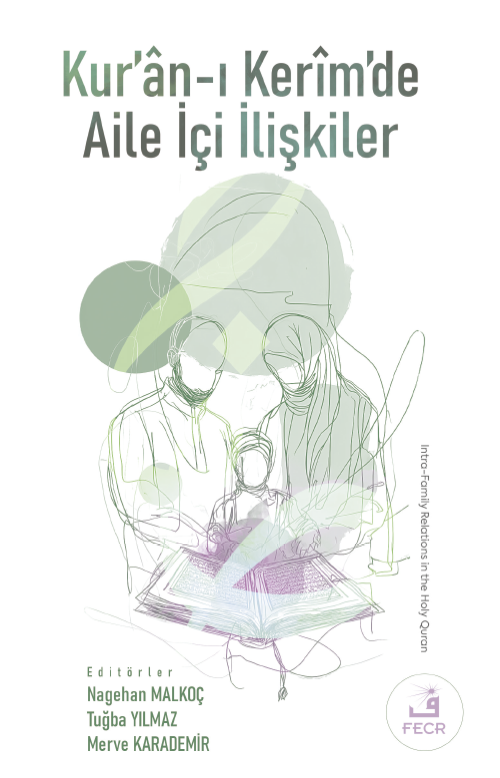
Intra-Family Relations in the Holy Quran
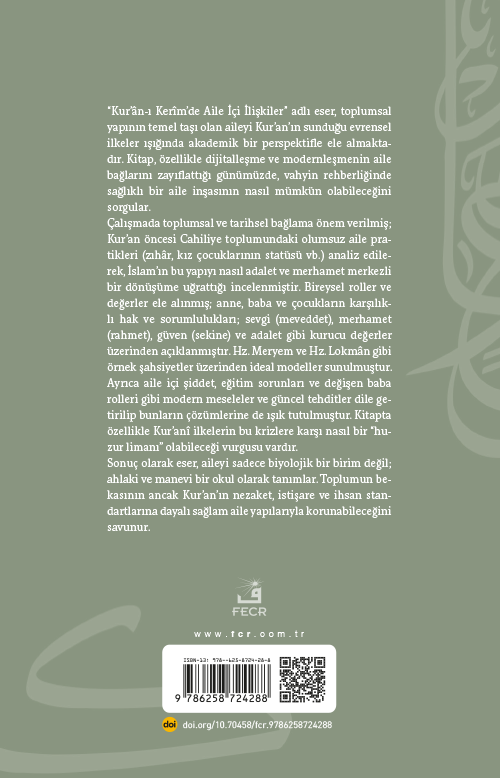
The work titled “Intra-Family Relations in the Holy Quran” is a comprehensive
academic study that examines the fundamental dynamics
of the family unit through the lens of the Quran. Within the context of
today’s rapidly changing social structure, the book analyzes the risks
faced by the family and the universal guidance offered by the Quran under
three main sections: 1. Family Within the Social Order: This section
emphasizes the indispensable role of the family in the social structure.
By analyzing positive family models (such as those of Prophet Abraham
and Prophet Moses) and negative models (such as the wives of Prophets
Noah and Lot, or Abu Lahab) mentioned in the Quran, it explains how
an ideal family structure should be built on the foundations of faith and
morality. Furthermore, it addresses the Quranic solutions to the “zihar”
tradition -a Pre-Islamic (Jahiliyyah) practice that victimized womenhighlighting
the principles of justice introduced by Islam.
2. Relations Among Family Members: This part focuses on the roles of
mothers, fathers, and children. It details the transformation of having a
daughter from a “source of shame” in the Jahiliyyah era into a source
of “divine grace and honor.” Key topics in this section also include the
mother’s dimensions of patience, mercy, and sacrifice, as well as her
inheritance and legal rights. 3. Intra-Family Roles and Education: The
final section explores rules of etiquette within the family, religious education,
and the struggle against domestic violence. While presenting
an educational model through Prophet Luqman’s advice to his son, the
concepts of “qawwam” and “sakinah” between spouses are reinterpreted
within the context of contemporary evolving parental roles. Conclusion
and Message: The central thesis of the work is that the family
is not merely a biological union but a moral institution built upon
love (mawaddah), mercy (rahmah), and justice. The book argues that
against modern threats such as digitalization and individualization,
Quranic principles-such as consultation (isharah), excellence (ihsan),
and kindness-serve as the safest harbor for preserving family integrity.
Keywords: Family; Mawaddah (Affection); Rahmah (Mercy); Justice;
Parent
| Genel Yayın No | 1814 |
|---|---|
| Marka | Fecr |
| Marka No | 1073 |
| ISBN | 9786258724288 |
| Yayım Tarihi | 31.12.2025 |
| Dil | |
| Boyut | 13,5 x 21 cm |
| Baskı Sayısı | 1 |
| Sayfa Sayısı | 264 |
| Kağıt Cinsi | 70 gr. Enzo |
| Kapak |