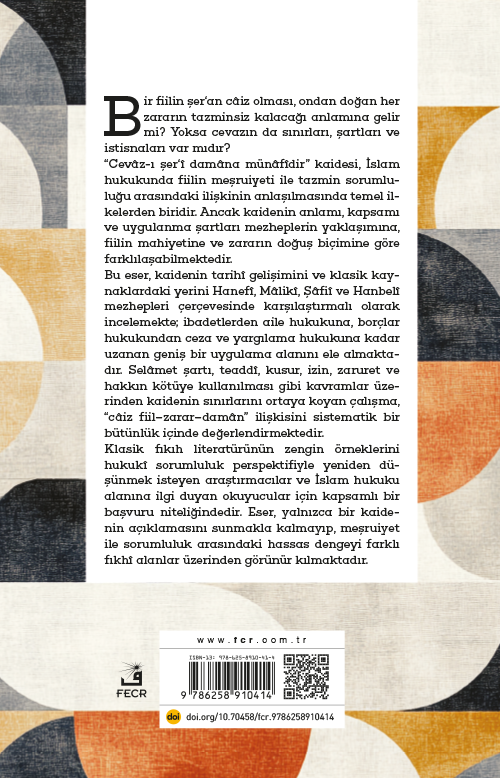
This study examines the relationship between permissibility (jawāz)
and liability (ḍamān) in Islamic law through the legal maxim “Permissibility
under Islamic Law Precludes Liability.” Proceeding from the premise
that questions of liability across different areas of Islamic jurisprudence
must be assessed by considering not only the consequences of an
act but also its legal character and the source, scope, and limits of the
authorization under which it is performed, the book adopts a comparative
approach to the maxim’s meaning, historical development, formulations
across the schools of Islamic law, and practical applications.
The study first explains foundational concepts such as permissibility,
liability, and authorization. It then examines the maxim’s antecedents
in early juristic practice, the process through which it acquired its established
wording, and its corresponding formulations in the Ḥanafī,
Mālikī, Shāfiʿī, and Ḥanbalī legal traditions. Alongside the maxim’s scriptural
and juristic foundations, the study discusses the conditions
under which the obligatory or permissible status of an act precludes
liability for the harm resulting from it.
The book illustrates the maxim’s practical implications through cases
concerning acts of worship, family law, obligations and contracts,
criminal law and judicial proceedings, and the public interest. It also
delineates the maxim’s limits by examining criteria such as the requirement
that an act cause no harm to others, transgression, fault, the
rights holder’s consent, necessity, and abuse of rights. In doing so, the
study seeks to present the classical juristic heritage within a systematic
framework, without treating the effect of legal permissibility on liability
as absolute, and to offer a conceptual contribution to contemporary
discussions of legal liability.
By identifying points of convergence and divergence among the schools
of Islamic law, this approach demonstrates that the maxim is a functional
criterion with concrete implications for everyday life, private
law, public order, and judicial proceedings, as well as a theoretical legal
principle. The book thus reveals the conceptual richness of classical
Islamic jurisprudence and contributes to a more comprehensive understanding
of the relationship between harm, liability, and legal authorization.
Keywords: Islamic jurisprudence (fiqh); Legal Maxim; Legal Permissibility
(Jawāz Shar’ī); Permission (Idhn); Liability (Ḍamān)


 İÇ SAYFALAR


