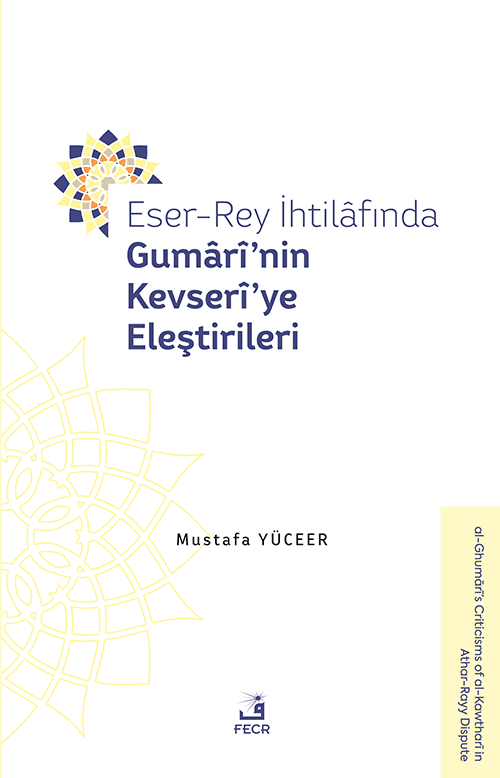
al-Ghumārī’s Criticisms of al-Kawtharī in Athar-Rayy Dispute
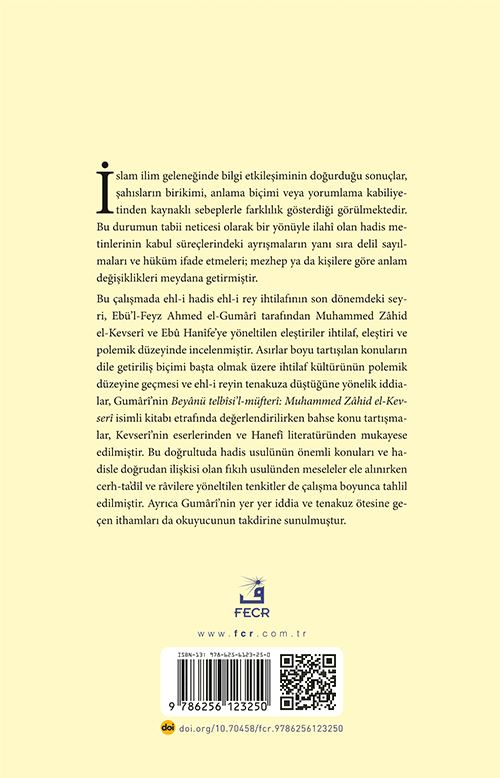
In the history of Islam, the disagreements between Ahl al-Hadith, which started with al-Shafi’i and established its existence after the Mihna, and Ahl al-Rayy, which is mostly identified with the Hanafi madhhab, have progressed around the meaning and methodological differences attributed to the evidence. While the claims and defences of both groups have been analysed by many authors, it is seen that the debates continue today. Indeed, the efforts of Ahmad al-Ghumārī (d. 1960), who defends the viewpoints of Ahl al-Hadīth as well as the viewpoints based on tajdīd that have developed in Egypt in the recent period, to commit al- Kawtharī (d. 1952), whom he considers Ahl al-Rayy, by identifying the discrepancies in his views, indicate that the dispute continues. Bayān al-telbīsi al-muftarī Muhammad Zāhid al-Kawtharī, which was published after al-Kawsari’s death, al-Ghumārī criticised some Hanafīs, especially Abū Hanīfa, and tried to identify contradictions from al-Kawtharī’s works. He developed a criticism around the narration that states that knowledge can be reached by a Persian even if it is in the star of Surya, and defended that Abū Hanīfa cannot be meant in the hadith. Apart from this, he claimed that al-Kawtharī criticized the imams of the sect and the ulema, especially the Companions, and he also mentioned his contradictions in hadīth and fiqh methodology. In the second part of his work, allegations of contradictions against the narrators were put forward. al-Ghumārī first determined that al-Kawtharī accepted a narration or a narrator, and then exemplified his rejection of the same naration or a narrator from al-Kawtharī’s works. The frequent use of insulting expressions in al-Ghumārī’s language and style, and his defining Abū Hanīfa as the prophet of the Persians and al-Kawtharī as the ummah of Abū Hanīfa are among the polemical elements that have theological consequences rather than accusations. In the course of the study, it was observed that al-Ghumārī gave incomplete or erroneous information in most of his claims of contradiction or did not take into account the methods followed by the Hanafīs regarding hadīths, while al-Kawtharī exhibited different perspectives on the criticisms made in previous periods in terms of jarh and ta’līl, especially in matters related to the rījal, although in our opinion there is no contradiction. Therefore, as a result of the findings, it can be concluded that al-Ghumārī’s work, which was written to shed light on the last period of the work-heritage controversy, is more oriented towards fictional claims and polemics rather than a scientific and methodical criticism.
Keywords: Ahl al-Hadith; Ahl al-Ray; Dispute; al-Qawsari; al- Ghumārī.

 İÇ SAYFALAR