This study examines one of the most influential orientalist and positivist
criticisms directed at Islam in the late nineteenth century: Ernest
Renan’s 1883 lecture entitled “Islam and Science,” along with the intellectual
responses it provoked in the Islamic world. In this lecture, Renan
argued that Islam constituted a structural obstacle to scientific progress
and associated Muslim societies with intellectual stagnation and irrationality.
His claims rapidly attracted widespread attention not only in
Europe but also within Ottoman intellectual circles.
The book first analyzes Renan’s ideological background in relation to
positivism, racial anthropology, and secular progressivism, demonstrating
that his critique of Islam was not merely scientific but also
deeply ideological and embedded within the colonial mindset of nineteenth-
century Europe. Renan’s anti-religious stance is shown to have
been shaped by his personal crises of faith, Eurocentric interpretation of
history, and strong adherence to Comtean positivism.
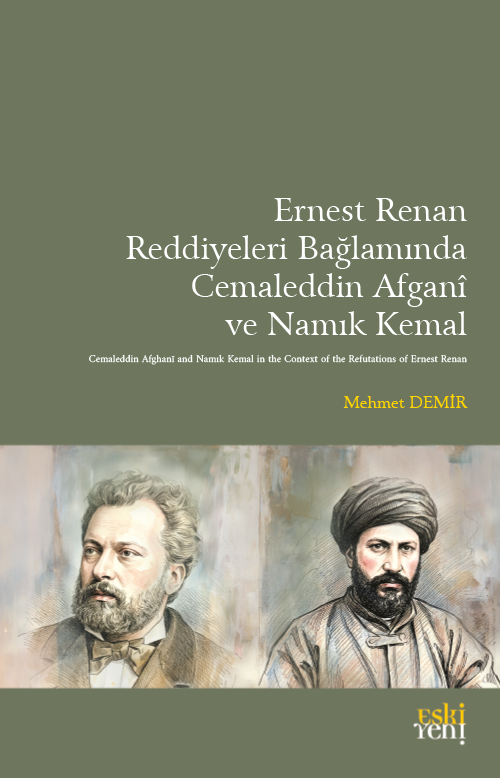
The main focus of the study lies in the two major rebuttals formulated
against Renan’s thesis: Cemaleddin Afghani’s French essay “Response
to Renan” and Namık Kemal’s independent treatise “Renan Defence”
(Renan Müdâfaanâmesi). Afghani’s response is critically assessed in
terms of its methodological weaknesses and its partial convergence
with some of Renan’s assumptions. In contrast, Namık Kemal’s refutation
is presented as a rigorously structured and intellectually robust
defence, grounded in both historical evidence and philosophical reasoning.
Kemal effectively challenges Renan’s reductionist generalizations
by demonstrating the deep historical relationship between Islam and
scientific inquiry.
The study ultimately argues that Renan’s discourse on Islam and science
functioned not as a neutral philosophical argument but as a legitimizing
tool for colonial ideology and racial hierarchies. The responses of
Afghani and Namık Kemal, on the other hand, are interpreted as early
manifestations of the Islamic world’s intellectual resistance to modern
Western epistemological dominance. By situating this debate within the
broader context of nineteenth-century global power relations, the book
offers a critical historical perspective on contemporary discussions surrounding
religion, science, and modernity.
Keywords: Renan; Islam and science; Cemaleddin Afghani; Namık Kemal;
Positivism

 İÇ SAYFALAR