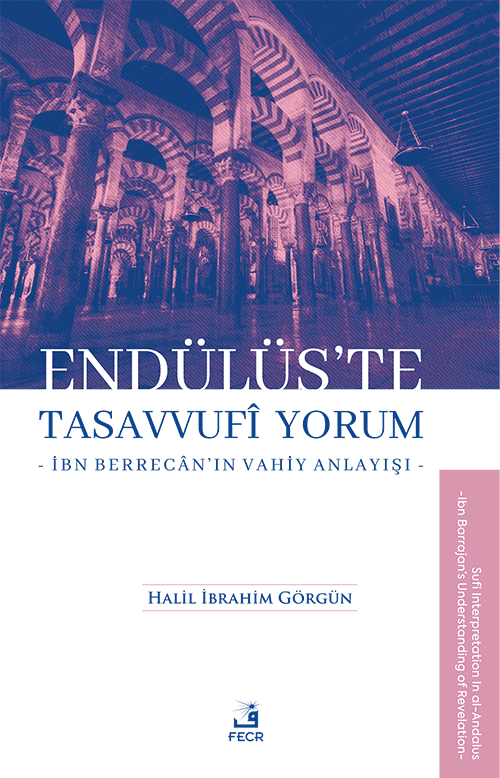
Sufı Interpretatıon In Al-Andalus -Ibn Barrajan’s Understanding Of Revelation-
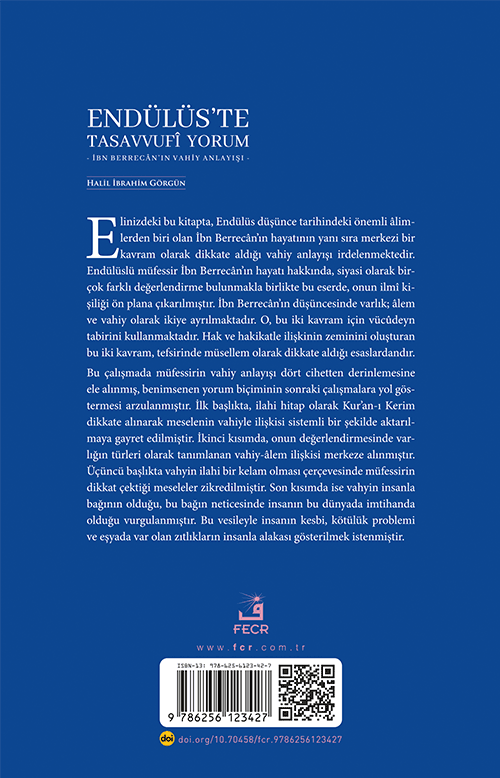
The book is divided into two sections, considering Ibn Barrajan’s worldview in the context of the concept of revelation. In the first section, the scholar’s life is touched upon in light of political discussions, and his scholarly personality is outlined by evaluating his works. Moreover, given that Ibn Barrajan was a multi-dimensional scholar, an overview of Andalusian religious thought is provided as a foundation for understanding his intellectual world. This part also shortly indicates the diversity of ideas, disciplines, and scholars in the Andalusian region. We evaluated the concept of revelation, which is the main subject of the book, in the second chapter. In addition, this concept is among the most important issues of the science of Tafsir. We focused on the idea of revelation, which is the introduction/conclusion to the activity of interpretation for Ibn Barrajan Ibn Barrajan regarded revelation as one of the types of existence along with the universe. In his terminology, the expression ”wujûdayn” (the two existences) signifies this idea. In exploring his understanding of revelation based on his works, we took an approach that encompasses his thoughts on existence and knowledge. Within this section, we systematically present the answers we found around key questions such as “What is revelation according to Ibn Barrajan?”, “With which concepts is revelation related?”, and “What is the relationship between man and revelation?” Therefore, we demonstrate that revelation is a concept interconnected with divine speech, the universe, divine names and attributes, and humanity within Ibn Barrajan’s thought. This book establishes that, from the scholar’s perspective, revelation as the Word of God was of central importance and that the idea of the Book of God encompassing all knowledge holds a foundational place. In al-Andalus, there were strong representatives of Sufism, and the notion of opposition to Sufism requires specific attention. Therefore, in al- Andalus, Sufism had representatives strong enough to be opposed by scholars with differing views. The thoughts and ideas of Ibn Barrajan are valuable in demonstrating the strength of the Sufi tradition. In addition, we may characterize his interpretation of the Qur’an not only as Sufi commentary but also as a theoretical/philosophical interpretation.
Keywords: al-Andalus; Religious Thought; Sufi Interpretation; Divine Names; Revelation; Ibn Barrajan; Wujûdayn

 İÇ SAYFALAR