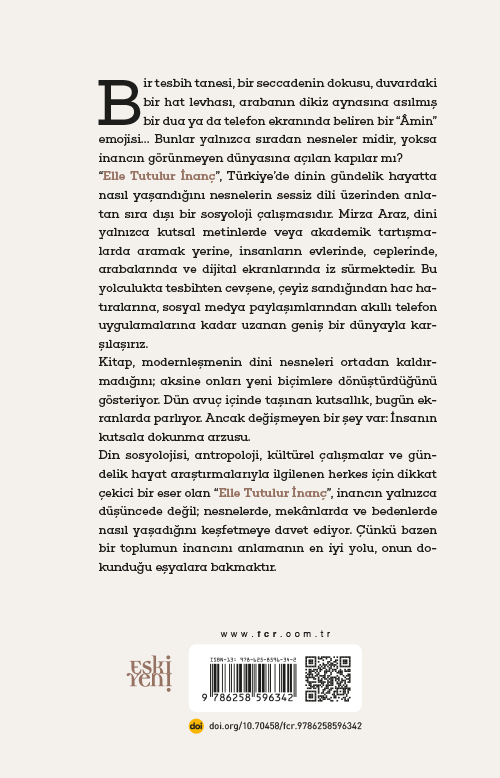
This book examines religion in Turkey not merely as a system of
beliefs, doctrines, or sacred texts, but as a lived experience embodied
through objects, spaces, and sensory practices. Positioned within the
field of Material Religion, the study challenges text-centered and
normative approaches that have traditionally dominated theological
and religious scholarship. Its primary objective is to explore how faith
becomes tangible in everyday life and how material objects participate
in the construction of religious experience.
Drawing upon Bruno Latour’s Actor-Network Theory, Birgit Meyer’s
Material Religion framework, and the sociology of the senses, the study
analyzes a wide range of religious objects and practices in contemporary
Turkey. These include prayer beads (tespih), prayer rugs, amulets, cevşen
texts, wall inscriptions, dowry items, pilgrimage souvenirs, and various
digital religious technologies such as Qur’an applications, social media
content, and smartphone-based devotional practices.
The book argues that religious objects should not be understood
merely as passive instruments. Rather, they function as active mediators
of memory, identity, emotion, and sacred presence. Through these
objects, believers establish meaningful connections with transcendent
realities and integrate religious values into everyday life. The
study further contends that modernization and secularization have
not eliminated material expressions of religion; instead, they have
transformed them into new forms. Digital screens, social media platforms,
and online religious interactions emerge as contemporary
manifestations of material religiosity.
Ultimately, the book demonstrates that religion cannot be fully
understood without considering its material, embodied, and sensory
dimensions. By focusing on tangible forms of faith, it offers a significant
contribution to the sociology of religion and the study of contemporary
religious life in Turkey.
Keywords: Material Religion; Sociology of Religion; Religious Objects;
Sensory Experience; Digital Religiosity


 İÇ SAYFALAR