Abu al-Tayyib al-Tabari’s Understanding of Jurisprudence -In the Context of al-Ta’līqat al-Qubra
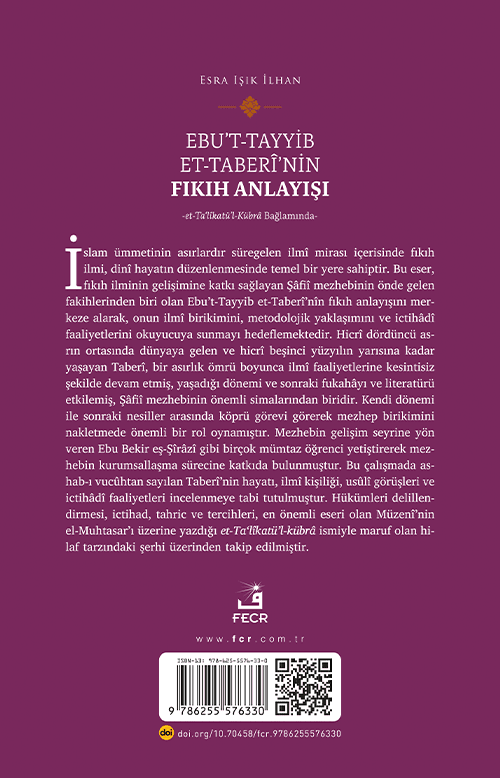
Abu al-Tayyib al-Tabari (d. 450/1058) is one of the early Shafi’i jurists who is considered one of the ashab al-wujūh. Abu Tayyib al-Tabari, who is considered one of the important names representing the Iraqi school and one of the scholarly authorities of his time, came to the forefront with his scholarly rigor, reliability, mastery of usul and furū’ issues, good morals and taqwa, and was praised by scholars both in his own period and later periods. Al-Tabari began to study at an early age and attended the lectures of many scholars in his hometown of Āmul, as well as in Jurjān, Dīnawar, Nīsābūr, and Baghdad, and was a student of many prominent figures in the sect, such as al-Khatīb al-Baghdādī (d. 463/1071), Abū Bakr al-Shīrāzī (d. 476/1083), and Ibn al-Sabbāgh (d. 477/1084). Deeply specialized in usul, jadal, madhhab, khilafah, hadith, and poetry, he wrote many works and played an important role in passing on his knowledge in these fields to the next generations. Among his works, his voluminous commentary on al-Muḥtasar of al-Musanī (d. 264/878), known as al-Talīqat al-Kubrā, became a work of great importance in his own time and in the following generations. This book is considered to be a successful example of the khilaf genre in that it includes the jurisprudential opinions of many names from the Companions to his own time. At the same time, since it was written in the early period, it is in a respectable position in terms of the usūlical information it contains and the usūl debates of that period. It is also of great importance in that it conveys both Imām Shāfiʿī’s views and the disagreements within the sect and often declares his preferences. In addition to his ijtihādī activities, which are mostly composed of his preferences, the author also makes intra-sectarian ijtihād and tahrîc in his work. In this study, al-Tabari’s jurisprudence is tried to be revealed through this work. In this context, the first chapter discusses al-Tabaris life, scholarly personality, the importance of the work, its content, methodology, and sources. In the second part, al-Tabaris method of proving the rulings and his legal opinions are analyzed. In the last section, the author’s jurisprudential ijtihad is emphasized. In this context, his ijtihad, tahrîc and preferences within the boundaries of the sect have been identified and analyzed.
Keywords: Islamic Law; Abu al-Tayyib al-Tabari; al-Ta’līqat al-qubrā; Usūli Views; Ijtihādī Activities

 İÇ SAYFALAR