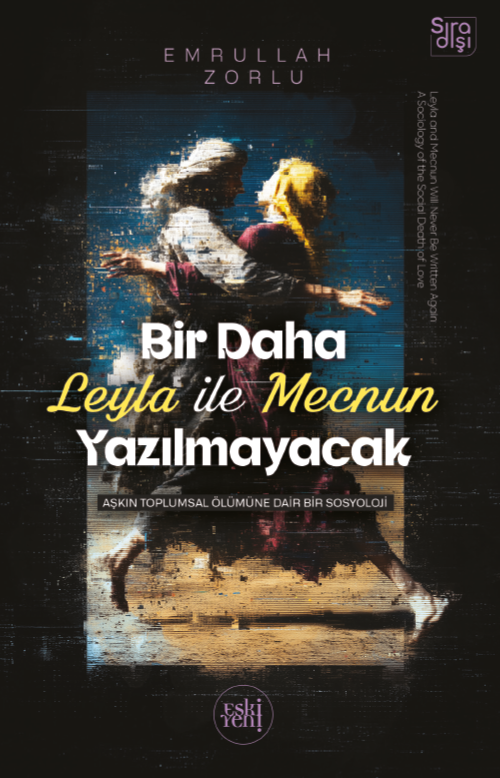
Leyla and Mecnun Will Never Be Written Again
A Sociology of the Social Death of Love
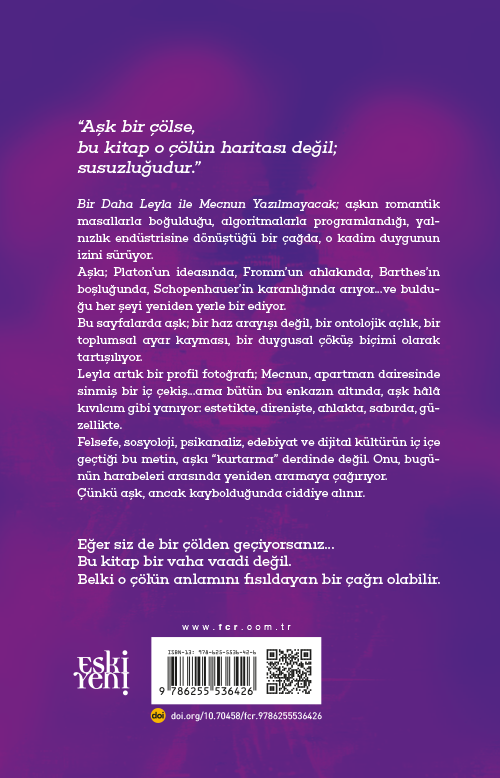
Examines the historical, cultural, and societal transformations of
love through a sociological lens. Drawing on the classical Leyla
and Mecnun narrative, Emrullah Zorlu explores the place of love
in collective memory, the changing emotional regimes, and its
loss of meaning in the modern world. Structured in five chapters,
the book analyzes the feudal conception of “unrequited and
distant” love, the individualized and rationalized forms of love
brought by urbanization, the superficial relationships produced
by digitalization, and the modern “loneliness industry.” Zorlu
argues that love is not merely an individual feeling but a
phenomenon shaped by social norms, gender roles, and cultural
values. Mecnun’s desert is interpreted as a metaphor for
resistance to social order, while Leyla’s silence symbolizes
femininity, waiting, and gender inequality. In the contemporary
era, love has been commodified within algorithms, data analytics,
and social media culture, losing its emotional depth. Treating the
loss of love as a form of cultural mourning, the work questions
whether a new form of social love is still possible. Drawing on
thinkers such as Heidegger, Fromm, Bauman, Illouz, Giddens, and
Barthes, the analysis discusses the role of love in social meaningmaking
beyond personal gratification. The book offers a critical
examination of the current state of love, contrasting the deep
bonds of the past with today’s shallow connections, and
provides readers with both sociological and philosophical
insights.
Keywords: Sociology of love; Leyla and Mecnun; Emotional regimes;
Digitalization and relationships; Collective memory

 İÇ SAYFALAR