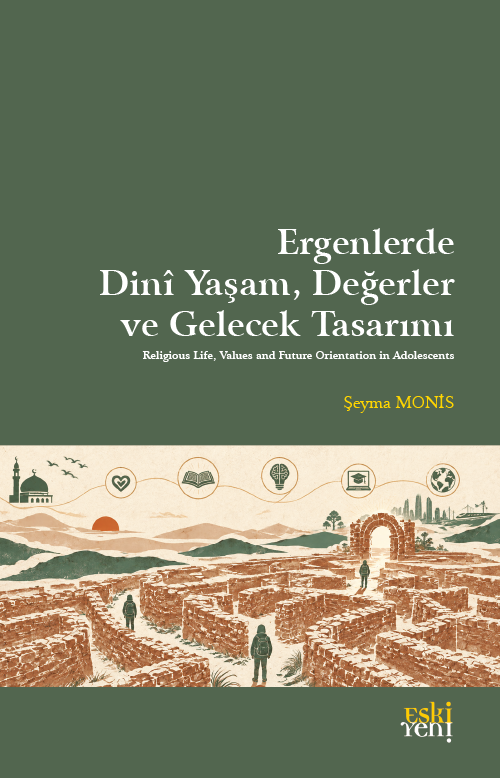
Religious Life, Values and Future Orientation in Adolescents
This study aims to provide an in-depth understanding of the effects of
religious life on values formed during adolescence and future design.
Interviews were conducted with a total of 6 groups involving 59 young
participants across different high school types. According to the findings,
a literal understanding of religion prevails among the participating
groups, regardless of high school type. The participant groups evaluate
their subjective religiosity within the framework of this literal understanding,
which specifically encompasses acts of worship, primarily
prayer. In this context, the majority of youth do not perceive themselves
as religious, with only twelve individuals evaluating themselves as
religious.
Under the theme of values, it was identified that youth lacked awareness
regarding the concept of values, except for the Science High School
group. The most paramount values for adolescents were family, followed
by homeland and religion, demonstrating that traditional values
remain prominent on a relational level. Students reached near-consensus
regarding the values they hold. Under the theme of future design,
participant groups expressed goals shaped around religion, family, and
career. However, youth were found to struggle with committing to a life
purpose and translating it into behavior.
Adolescents were generally found to be satisfied with their social environments.
Although some youth expressed dissatisfaction with their
family dynamics due to various reasons, family remained a significant
value to them, and they expressed a desire to start a family or make
their family proud. Accordingly, cultural and traditional perspectives
are key factors influencing not only the religious domain but also value
formation and future design. During discussions, only one participant
exhibited an inquiring, rational, and critical attitude—a cognitive characteristic
of adolescence.
In conclusion, although religious practice is not embraced as an individual
identity, it exerts an influence on adolescents’ lives as a social
identity. Traditional and cultural modes of thought predominate among
students in a relational context, while rational, critical, and inquiring
attitudes remain limited. Consequently, religion is lived as a product
of social consensus, continuing to function as a bond that holds society
together. However, such a perception of religion is considered to remain
limited in generating values and manifesting in behavior.
Keywords: Religion; subjective religiosity; values; purpose in life; future
orientation; Structure

 İÇ SAYFALAR


