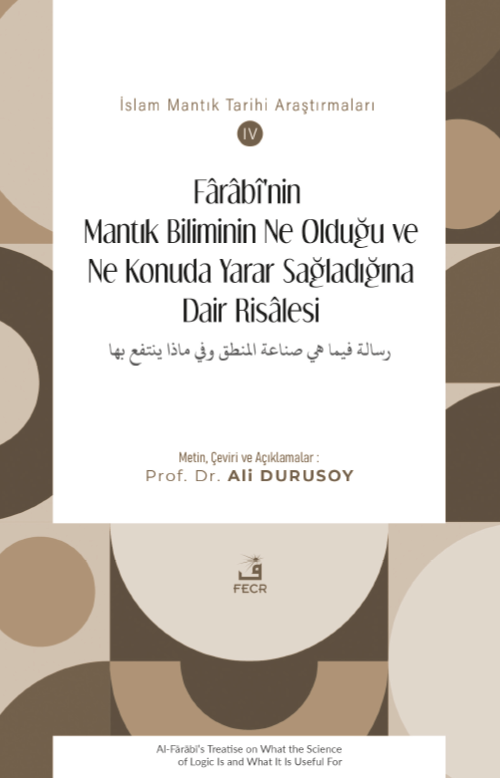
Al-Fārābī’s Treatise on What the Science of Logic Is and
What It Is Useful For
This study aims to demonstrate that the short treatise entitled
Risāla fīmā hiya ṣināʿat al-manṭiq wa-fīmā dhā yuntafa
ʿu bihā (“A Treatise on What the Science of Logic Is and
What It Is Useful For”), which was previously published as
the work of an unknown author, was in fact written by al-
Fārābī. The treatise is found in a manuscript miscellany
copied in 557/1162 and was published by Mehdi Moḥaqqeq
in 1974. The absence of any attribution of the treatise in
classical biographical sources, bibliographies, and modern
studies on al-Fārābī makes the question of its authorship
particularly significant. To address this problem, the study
primarily compares the treatise’s content, language, terminology,
and conceptual structure with works whose attribution
to al-Fārābī is considered certain. This method is
characterized as “intra-systemic verification.” The treatise
begins with the premise that human beings naturally desire
to increase their knowledge. Through the rational faculty
(al-quwwa al-nāṭiqa), human beings acquire, distinguish,
contemplate, and learn knowledge. Language, in
turn, enables people to communicate their mental contents
to one another and makes social cooperation possible. Yet
not all knowledge is immediately evident. Syllogism is
required to arrive at knowledge of what is hidden on the
basis of what is evident. According to al-Fārābī, logic is the
science that provides the rules for constructing correct
syllogisms and protects the mind from error. Accordingly,
logic is not merely a theoretical discipline but also an instrument
for correct reasoning and the acquisition of
knowledge in other sciences. One of the study’s notable
findings is that the concepts of fiṭra, maʿrifa, al-quwwa alnāṭiqa,
syllogism, istinbāṭ, and qudamāʾ in the treatise closely
correspond to those found in al-Fārābī’s other works.
It is also demonstrated that the systematic structure of the
treatise, progressing from human nature to knowledge,
language, and syllogism, is consistent with the method found
in his other writings. The study therefore argues that
the treatise constitutes an important source for understanding
al-Fārābī’s conception of logic.
Keywords: al-Fārābī; Logic; Grammar; Syllogism; Religion;
Knowledge

 İÇ SAYFALAR