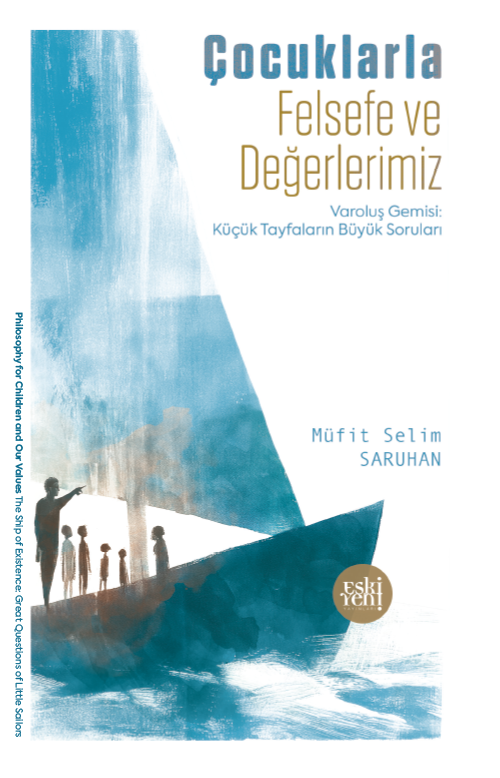
Philosophy for Children and Our Values
The Ship of Existence: Great Questions of Little Sailors
Is an interdisciplinary study designed to guide children’s intellectual,
moral, and emotional development through philosophical
inquiry and values education. Drawing upon philosophy, ethics,
educational sciences, psychology, and pedagogy, the book offers
both a theoretical framework and practical methods for engaging
children in meaningful conversations about values.
The primary aim of the work is not merely to transmit information
but to help children understand themselves, others, and the
world around them more consciously. To achieve this goal, fundamental
human values such as curiosity, questioning, critical
thinking, empathy, justice, honesty, responsibility, courage, tolerance,
and environmental awareness are explored through ageappropriate
stories, dialogues, reading passages, and educational
activities.
One of the distinctive contributions of the book is its philosophical
narrative entitled “The Ship of Existence”, which introduces
young readers to major thinkers such as al-Kindī, al-Fārābī,
Avicenna (Ibn Sīnā), Averroes (Ibn Rushd), Ibn Ṭufayl, Ahmad
Yasawī, and René Descartes. Through this imaginative voyage,
children encounter fundamental philosophical questions and discover
the shared intellectual heritage of humanity in a manner
suitable to their developmental level. Classical virtues such as
wisdom, justice, temperance, and courage are also illustrated
through examples from everyday life.
Rather than adopting a didactic and prescriptive approach, the
book emphasizes the language of love, empathy, dialogue, and
participatory learning. It highlights the roles that parents and
educators can play in supporting children’s moral and intellectual
growth while offering practical methods such as storytelling, roleviii
playing, group discussions, moral dilemma activities, and social
responsibility projects.
The volume contains twenty-eight thematic reading texts addressing
topics including family relationships, friendship, selfconfidence,
time management, environmental responsibility,
compassion for animals, aging, cooperation, honesty, nature, and
the love of learning. These texts are designed to foster both personal
development and social awareness among children.
Ultimately, the book seeks to teach children not only what to
think, but more importantly how to think. It aims to cultivate
critical reasoning, moral judgment, intercultural understanding,
and a virtue-centered outlook on life. As such, it serves as a valuable
resource for parents, teachers, counselors, and all educators
interested in nurturing thoughtful, responsible, and ethically
aware future generations.
Keywords: Philosophy for Children; Values Education; Moral
Education; Child Development; Critical Thinking; Virtues; Character
Education; Empathy; Multiculturalism; Family Education; Environmental
Awareness; Child Psychology; Ethics; Philosophical
Inquiry; Children’s Literature.

 İÇ SAYFALAR