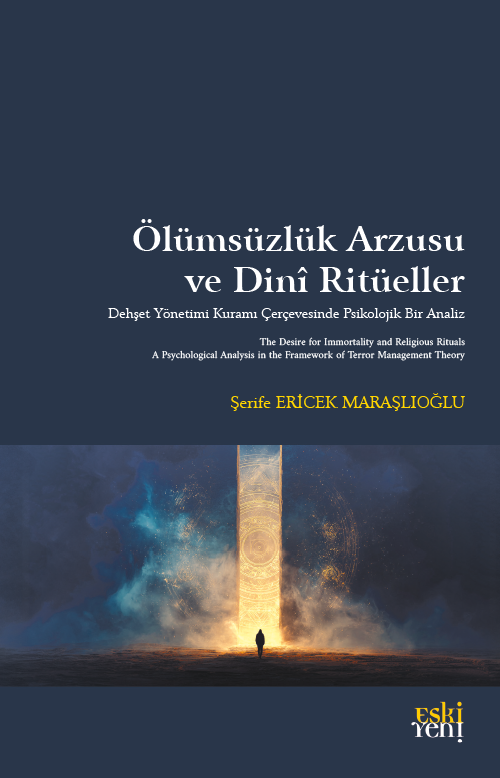
The Desire for Immortality and Religious Rituals
A Psychological Analysis in the Framework of Terror
Management Theory
This study aims to examine, from a religious psychology perspective, the
desire for immortality that humans develop in the face of death awareness
and how this desire is interpreted through religious rituals. As the
only being aware of its own mortality, humans experience an existential
tension between the inevitability of death and the need to make their
lives meaningful and sustainable. This tension demonstrates that death
is a fundamental existential reality that shapes an individual’s self-perception,
value systems, and world of meaning. In this context, death
awareness is considered a multidimensional psychological phenomenon
at the center of an individual’s identity construction, meaning production,
and existential coping processes. The literature on psychology and
psychology of religion shows that thoughts of death trigger feelings of
anxiety and uncertainty in individuals, but also activate their search for
meaning and efforts to maintain identity integrity. In this context, the
desire for immortality emerges as one of the fundamental existential
orientations developed by the individual in the face of the threat of
annihilation. On a theoretical level, this phenomenon is addressed within
psychoanalytic approaches, existential psychology, and particularly
the Terror Management Theory. The Terror Management Theory argues
that existential anxiety arising from death awareness is regulated
through cultural worldviews and self-esteem. In this context, religious
beliefs and rituals are considered powerful cultural and symbolic mechanisms
that regulate existential anxiety in the face of death. Religious
practices such as prayer, worship, and mourning rituals contribute to
the individual’s understanding of the ontological uncertainty created
by death and to the preservation of self-continuity. However, in the
existing literature, this process has mostly been examined using quantitative
methods, and how the desire for immortality is structured in the
individual’s subjective experience has not been sufficiently explained.
In this study, based on this gap, how individuals make sense of their
viii
desire for immortality in the face of death awareness through religious
rituals was examined using an interpretive phenomenological analysis
method. The research aims to examine how religious rituals contribute
to the individual’s reestablishment of self-continuity. It also aims to
reveal whether rituals function as psychological regulatory mechanisms
that position life within a horizon of meaning extending beyond death.
Keyword: Psychology of Religion; Death Awareness; Desire for Immortality;
Religious Rituals; Terror Management Theory

 İÇ SAYFALAR