0 Items - ₺0,00
- Sepette hiç bir ürün yok.

Orijinal fiyat: ₺220,00.₺150,00Şu andaki fiyat: ₺150,00.
 İÇ SAYFALAR
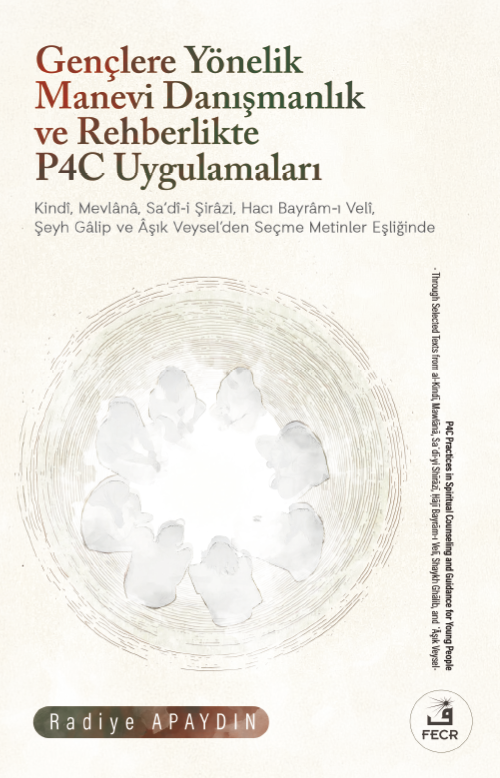
P4C Practices in Spiritual Counseling and Guidance for Young People
Through Selected Texts from al-Kindī, Mawlānā, Saʿdī-yi Shīrāzī, Ḥājī Bayrām-ı
Velī, Shaykh Ghālib, and ʿĀşıḳ Veysel
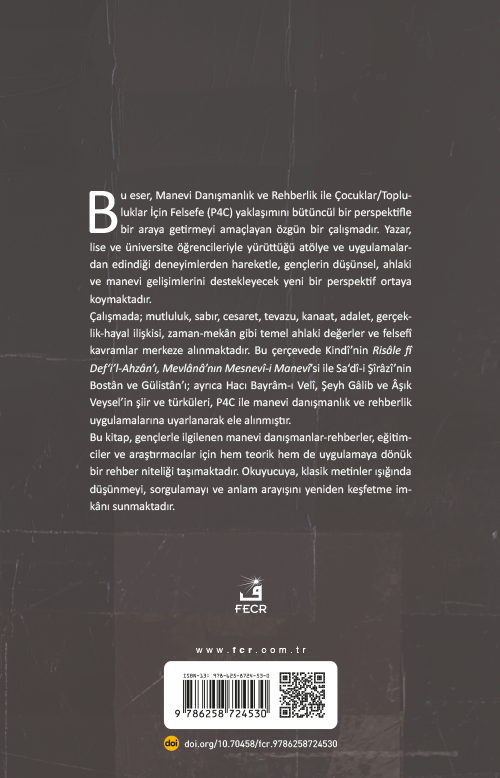
This research examines the integration of the P4C (Philosophy For Children/Philosophy
For Community) method into spiritual counseling and guidance processes, analyzing how
it may affect individuals’ spiritual development, internal inquiry, and cognitive-social
processes. It also investigates whether P4C has an effect that strengthens group dynamics
and what role it plays in creating a safe spiritual guidance environment.
This study was conducted using qualitative research methods and document analysis.
Document analysis is considered an important qualitative research method that includes
books, magazines, letters, diaries, newspapers, photographs, memoirs, interviews, pictures,
videos, and similar written and visual materials. The reason for choosing this method
in our study is that the basic data of the research consists of written and existing
sources. Within this scope, Spiritual Counseling and Guidance processes were addressed
using the P4C method; in this context, story examples, sources related to the field of Spiritual
Counseling and Guidance, the Presidency of Religious Affairs’ Youth Guidelines,
guidebooks containing the basic principles of P4C, and academic theses and publications
were utilized. Books, articles, master’s and doctoral theses were used in the process of examining
and comparing the structures of MDR and P4C and revealing their overlapping
and non-overlapping aspects; each document examined was selected taking into account
its own context and target audience, and the data obtained was evaluated from an objective
perspective.
This research examines the integration of the P4C (Philosophy For Children/Philosophy
For Community) method into spiritual counseling and guidance processes, analyzing how
it may affect individuals’ spiritual development, internal inquiry, and cognitive-social
processes. It also investigates whether P4C has an effect that strengthens group dynamics
and what role it plays in creating a safe spiritual guidance environment.
Keywords: Spiritual Counseling and Guidance; P4C; Philosophy of Values; Youth Studies;
Application Examples
| Genel Yayın No | 1853 |
|---|---|
| Marka | Fecr |
| Marka No | 1098 |
| ISBN | 9786258724530 |
| Yayım Tarihi | 27.02.2026 |
| Dil | |
| Boyut | 16 x 24 cm |
| Baskı Sayısı | 1 |
| Sayfa Sayısı | 126 |
| Kağıt Cinsi | 70 gr. Enzo |
| Kapak |