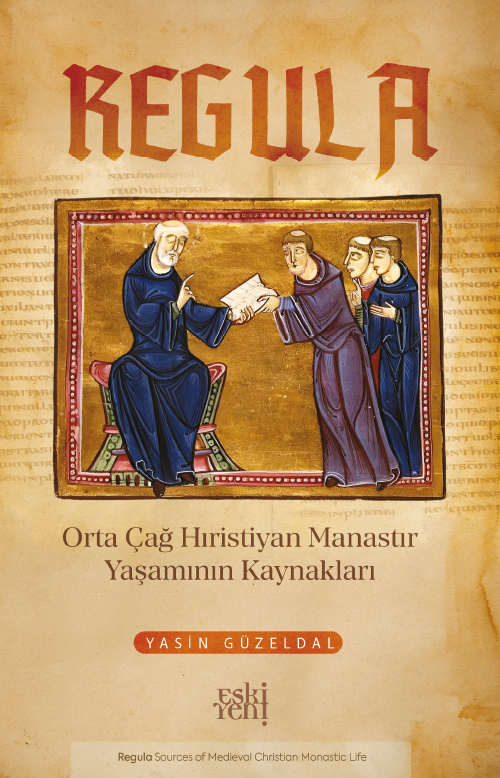
Regula
Sources of Medieval Christian Monastic Life
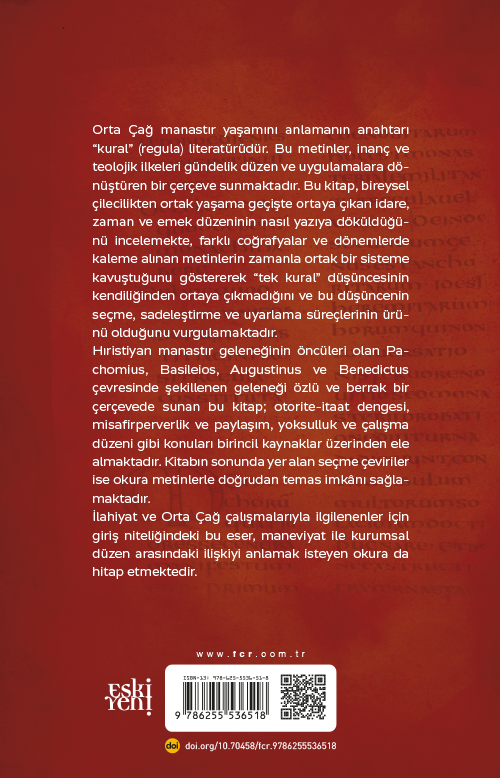
This study discusses the emergence, circulation, and gradual evolution
into a singular normative framework of the “rule” (regula) literature
that shaped Christian monastic life from Late Antiquity to the Early
Middle Ages. The starting point is the transition from individual ascetic
(eremitic) experiences to the need for a minimum order to sustain
communal life (cenobitic). In this context, Pachomius’s federative community
model; Basil’s Asketikon with its theological-moral backbone;
Augustine’s rules with their urban/institutional community ethics; and
finally, Benedict’s Regula Benedicti text with its balance of moderation,
obedience, and work-prayer (ora et labora) are positioned at the center.
The study shows that the idea of a “single rule” did not arise spontaneously,
but was institutionalized through processes of selection, compilation,
and interpretation. Benedict of Aniane’s Codex regularum and
Concordia regularum initiatives synchronized the scattered corpus; The
trend of blending, which began with the “regula mixta” practices of the
7th century, culminated in the Regula Benedicti becoming a reference
norm on an almost imperial scale after the Carolingian reforms and
the synods of Aachen (816-819). Methodologically, the study offers a
comparative reading based on selections from primary texts, tracing the
relationship between the crystallization of authority and institutional
practices. Ultimately, it argues that a polyphonic tradition was bound
to a pragmatic common measure; that the tensions between the intention
to set norms and historical retrospection (retrospective normativization)
were made visible within a balanced framework. Furthermore,
at the end of the book, selections from fundamental monastic rules (Pachomius,
Basileios, Augustine, Benedict, and Francis) are included in
Turkish translation, thus making the discussed normative framework
directly accessible through the texts themselves.
Keywords: Christianity; Early Middle Ages; Monastic Rules; Pachomius;
Basileios; Augustine; Benedict

 İÇ SAYFALAR