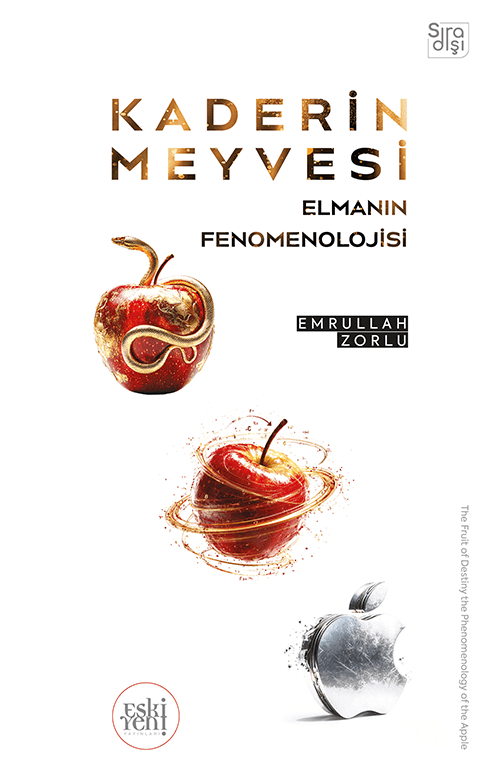
The Fruit of Destiny The Phenomenology of the Apple
When you hold an apple in your hand, you begin to think — though you may not realize it. How strange it is that the world’s most ordinary fruit has inspired humanity’s most extraordinary thoughts. Perhaps the pursuit of truth sometimes begins by following the trace of an apple. This book is the story of that first bite.
The apple is not in the kitchen nor at the greengrocer’s; it stands on the stage of history. From Adam’s hand to Newton’s head, from Steve Jobs’ fingerprint to the ideological horizon of the Red Apple (Kızılelma), it travels across a vast and symbolic landscape. This book follows that journey—unveiling the extraordinary human story concealed behind an ordinary fruit.
The Fruit of Destiny – The Phenomenology of the Apple doesn’t treat the apple as a mere biological object, but as a phenomenon shaped by cultures, philosophers, scientists, poets, and artists alike. In Emrullah Zorlu’s hands, the apple becomes the vessel of both thought and emotion. Sometimes it symbolizes the fall, sometimes the ascent, sometimes the very tension of contradiction. Here, the apple is considered in its total experience: the anxiety before the bite, the awakening after it, and even in decay, the meanings it continues to carry.
The book’s content is not only philosophical or historical—it is poetic, ironic, and deeply thought-provoking. Each page opens with a sense of discovery; each chapter invites the reader into a new layer of human consciousness. From Newton’s fallen fruit to Steve Jobs’ glowing logo, from Eden to Silicon Valley, this narrative challenges us to reflect on our relationship with existence through a single fruit. It’s not the apple itself that matters, but the echoes it stirs in our minds as we look at it.
In these pages, philosophers debate the apple: Kierkegaard sees in its rot a seed of hope, Nietzsche finds in its ripeness a surge of Dionysian power, Spinoza recognizes the necessity of the universe, and Camus dreams not of Sisyphus’ rock, but of the apple’s cooling shade. Painters blur our faces with apples, poets hide solitude in its peel and truth in its core. From Rilke to Blake, Sylvia Plath to Âşık Veysel, many voices echo through this fruit. Sometimes, a poem lives inside an apple.
Despite its philosophical richness, the book offers a refreshing tone. Written in a style inspired by popular authors—fluid, charming, and imaginative—it replaces academic rigidity with thoughtful elasticity. Readers might think like a philosopher, dream like a child, and investigate like a detective. Its language is accessible to both casual readers and deep thinkers, spanning levels of curiosity and background.
The Fruit of Destiny teaches us to look again at the “simple.” Perhaps the most magical things are those we see every day but never truly notice. This book creates that moment of attention—inviting us to look, to think, and to feel again. Because sometimes, one apple is all it takes to understand the world.
Keywords: Apple; Phenomenology; Mythology; Transformation; Consciousness



 İÇ SAYFALAR