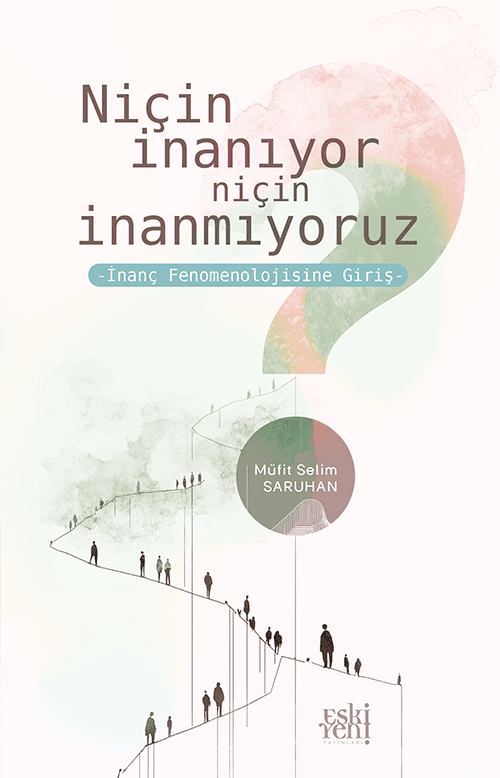
Why Do We Believe Why Don’t We Believe -An Introduction to the Phenomenology of Belief-
This book traces the path of a reflective inquiry that seeks neither to glorify belief nor to dismiss unbelief, but instead to think through both-alongside the reader. It observes that responses to fundamental questions such as Why do we believe? or Why don’t we believe? are often shaped by imitation, cultural conditioning, or superficial sociological assumptions, lacking in depth or self-awareness. Rather than providing definitive answers, the author invites us to explore where these questions might lead us-both mentally and existentially.
The book explores the phenomenological appearances of religion in society through the key concepts of horizon, tranquility, and chaos. These serve as conceptual lenses to understand how religion is perceived across different contexts. Building on this, the author proposes a framework to understand belief not only through emotional or cultural dimensions but also through conceptual foundations. Drawing from Aristotle’s four causes and classical philosophical categories such as substance, relation, time, and place, the author attempts to reinterpret these traditional tools as cognitive modes that shape how we engage with belief-not merely as abstract theory but as practical ways of thinking.
Taking a brief journey through philosophical traditions, the author revisits Ibn ‘Arabī and al-Fārābī in Islamic thought-highlighting Ibn ‘Arabī’s openness to pluralism and al-Fārābī’s rationalist synthesis of philosophy and religion. In the Western tradition, figures like Locke, Hume, Kant, and Spinoza are engaged-not as final authorities, but as thinkers whose views on belief can help us ask deeper questions about our own. None are absolutized; each is offered as a thoughtful companion on the journey.
The author turns to the interpretive plurality of religious texts, questioning how these varying interpretations shape belief, identity, and sometimes tension. How does religion appear differently when perceived through a poetic, dialectical, or rational lens? If every person understands differently, must religious texts always be reinterpreted? On what grounds do we relate to the sacred?
At the heart of the book lies the question Why? Belief or unbelief is rarely a final destination; it is more often the product of experience, confrontation, fear, hope, and reflection. Thus, rather than advocating a single position, the book calls on the reader to embark on their own intellectual journey: to think, to pause, to question, and sometimes-to begin again.
This is not a book of final answers. But it is an invitation to look behind every answer and examine the question that gave rise to it. Because belief and unbelief are not ultimate positions-they are forms of travel, each with their own inner landscapes.
Keywords: Phenomenology; Theory of Reasons; Categories; Philosophy of Religion; Meaning of Life; Belief; Culture; Philosophy

 İÇ SAYFALAR