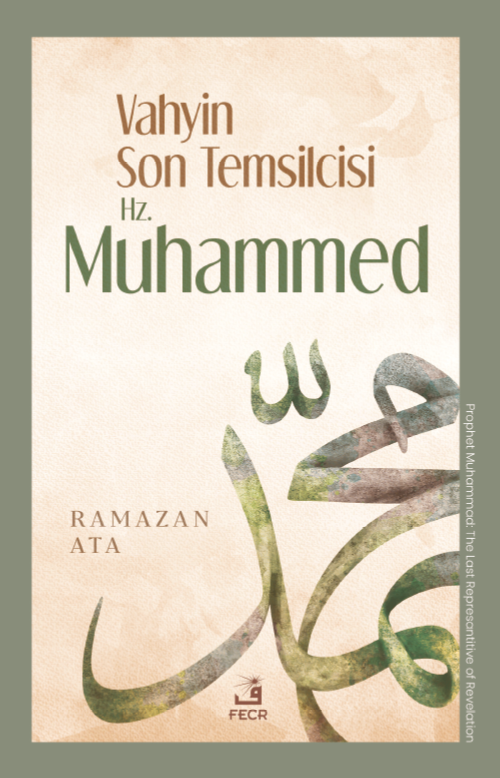
The Final Messenger of Revelation Prophet Muhammad
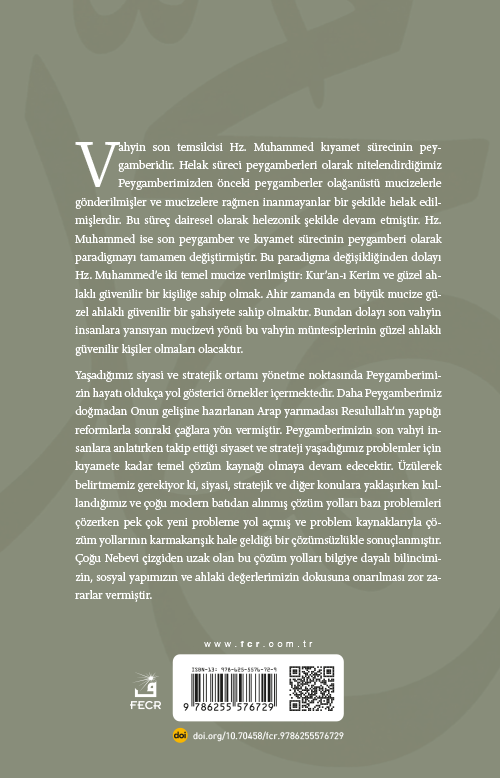
A mindset that once elevates a civilization to its peak can, in time, become
the greatest obstacle to its further development. Overcoming such
an obstacle requires a transformation of the prevailing paradigm. When
we look at world history, we see that—aside from certain exceptions—
singularity and monarchical rule have often dominated. The most practical
form of governance was perceived as the rule of the strongest or of
a single ruler, and thus this model largely prevailed throughout history.
Yet, by the 20th century, democratic systems began to flourish. However,
with the mission of the Last Prophet, Hz. Muhammad, this understanding
was challenged long before, and humanity was invited instead
to embrace consultation (shura) and pluralism until the end of time.
In tracing the development of human history, one observes that among
the most significant paradigmatic shifts—perhaps the very first—is the
emergence of pluralism and consultative governance. Even before Islam,
there were occasional practices that reflected elements of consultation
leading toward pluralism and democracy. Yet, it is possible to state
that the first systematic embodiment of pluralism was realized through
Prophet Hz. Muhammad and his earliest followers. Through the Qur’an
and the Prophet’s persistent emphasis on consultation, the foundations
of pluralism and democratic practice were laid. The processes of compiling
and preserving the Qur’an, as well as the election of the first
caliphs, stand as clear and original examples of this consultative spirit.
This vision extended from politics to law, from Qur’anic exegesis to hadith,
permeating many aspects of Islamic thought and practice.
For those who believe in God and in His revelation, the Qur’an is the
ultimate and decisive proof concerning the prophets, especially Hz. Muhammad.
Without the Qur’an, it is impossible to establish the miracles
attributed to any prophet of the past with certainty. Islam, in its call
to faith in God and His Oneness, relies solely on rational proof and
on the natural laws governing human thought. It does not overwhelm
humanity with the extraordinary, nor does it blind human reason with
unfamiliar displays. It does not shatter intellectual integrity with an
overpowering divine cry. Rather, the Prophetic paradigm established
by the Final Messenger of Revelation, Hz. Muhammad, rests upon the
principles of brotherhood, equality, and pluralism among all believers.
Throughout his life, the Prophet consistently emphasized and embodied
human equality. Bilal al-Habashi, of African descent; Salman al-Farisi,
of Persian origin; and Suhayb al-Rumi, of Byzantine background, all
stood shoulder to shoulder in his service. At the conclusion of his 23
years of prophethood, Prophet Hz. Muhammad succeeded in transforming
a society steeped in ignorance (jahiliyya) into the Age of Happiness
(‘Asr al-Sa‘adah), founded upon the principles of justice, equality, consultation,
pluralism, and the fraternity of faith.
Keywords: Prophet Hz. Muhammad; Islamic History; Pluralism; Consultation;
Paradigm Shift

 İÇ SAYFALAR