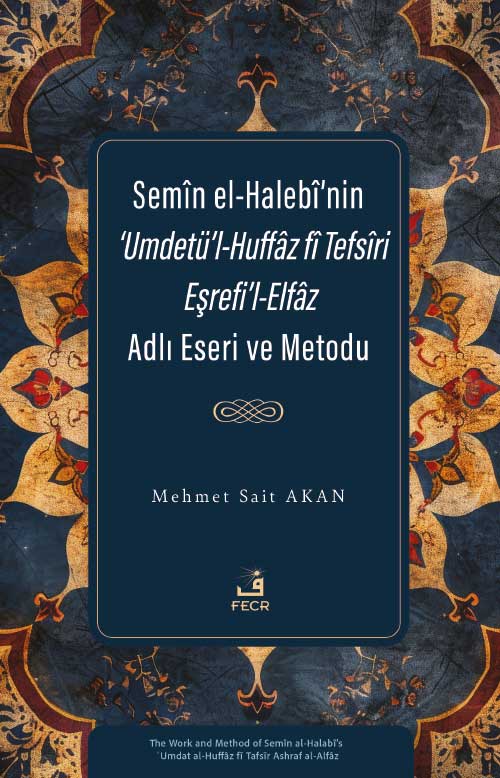
The Work and Method of Semîn al-Halabî’s
ʿUmdat al-Huffâz fī Tafsīr Ashraf al-Alfâz
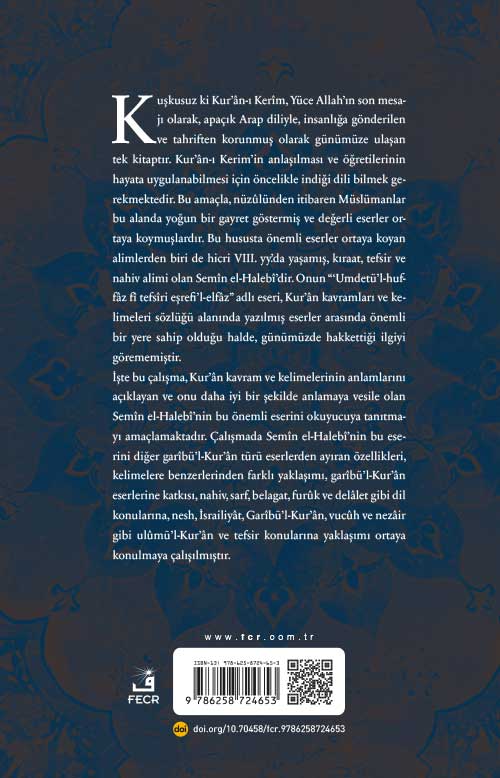
This study we have done about Semin el-Halebî’s work called “Umdah
al-huffāz fī tafsīr al-ashraf al-alfāz” and his method consists of an introduction
and four chapters. The introduction provides an overview of
the subject and importance of the research, the methodology employed,
the resources used and studies related to research. The first chapter of
this study concerns the period in which al-Samīn al-Halabī who was a
sophisticated scholar lived in the VIII/XIV century and influenced many
scholars after himself, including a discussion of his life, his teachers, his
students, his scientific personality, his tafsir, his works, and his Umdat
al-huffāz and its sources. In the second chapter of this study explained
Samīn al-Halabī’s methodology in Umdah al-huffāz, comparison of
Umdah al-huffāz with Haravî’s al-Garîbayn and Râgib’s al-Mufradât,
the features that distinguish it from other Garîb al-Qurʼan works, its
approach to words unlike its counterparts and his contribution to the
works of the Garîb al-Qur’an. In addition, in this section, scholars who
were influenced by Samîn and quoted from her or made evaluations
about ‘Umdetü’l-huffâz are also mentioned. This section also mentions
the scholars who were influenced by al-Samīn and quoted from him or
made evaluations about “Umdah al-huffāz.” While explaining the words
in this work, Samîn followed an alphabetical order, cited the verses in
which the words were mentioned, explained the meanings of the words
in detail, and sometimes tried to determine the actual meaning of the
words. In the third chapter, the linguistic aspect of “Umdah al-huffāz”
discussed. The importance of the Arabic language for understanding the
Qur’ān is emphasized, and Samīn’s general approach to linguistics is
discussed. In addition, in the context of ‘Umdah al-huffāz’s perspective
on linguistic sciences, her approach to the meaning of words, nahw-sarf
and rhetoric are explained. In this section, it is concluded that Samîn
used language issues skillfully in this work. In the fourth chapter, the
tafsir and ulūm al-Qurʾān aspects of “Umdah al-huffāz” were analyzed.
In this context, it has been determined that Samîn, who also applied to
narrated exegesis, showed his true exegesis in dirayah tafsir (ray tafsir).
Even though ‘Umdah al-huffâz is not a book of ulûm al-Qur’an, it has
touched on the subjects of ulûm al-Qur’an in many places in the context
of verses.
Keywords: The Holy Quran; Tafsir; Ulūma’l-Qurʾān; Samīn al-Halabī;
‘Umdah al-huffāz, Qur’an Dictionary