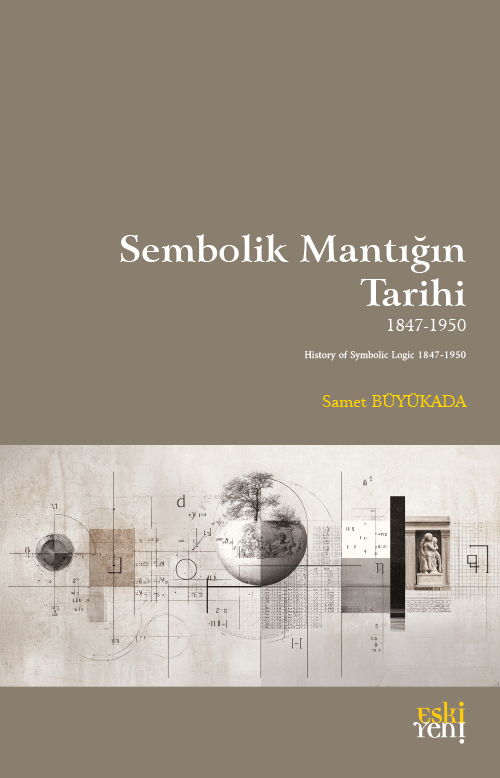
History of Symbolic Logic 1847-1950
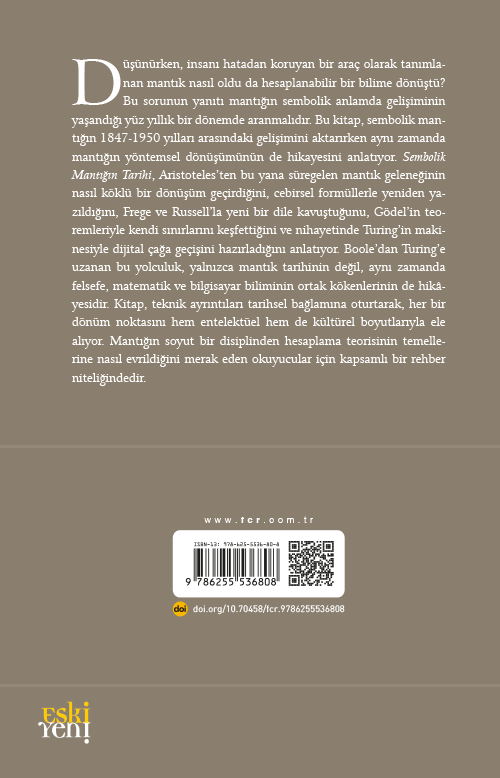
This work examines the historical development of symbolic logic between
1847 and 1950 from an academic perspective. This century-long
period, extending from George Boole’s algebraization of logic to Alan
Turing’s theory of computability, represents the transformation of logic
from a philosophical discipline into a mathematical and formal science.
The book progresses through four fundamental transformative phases:
the Algebraization Period (1847-1880), the Predicate Logic Period
(1879-1921), the Meta-Mathematical Period (1920-1934), and the
Computability Period (1936-1950). Key milestones such as Augustus De
Morgan’s theory of relations, Gottlob Frege’s predicate logic, Bertrand
Russell’s theory of descriptions, Kurt Gödel’s incompleteness theorems,
Alfred Tarski’s truth theory, and Turing’s universal machine are systematically
analyzed. The work presents the epistemological, methodological,
ontological, and pragmatic transformations of logic within their
historical context, aiming to illuminate the intellectual foundations of
modern logic and computer science. Prepared to fill a gap in Turkish
logic historiography, this study offers a comprehensive resource for researchers
in philosophy, theology, mathematics, and computer science.
Keywords: History Of Logic; Symbolic Logic; Algebraic Logic; Predicate
Logic; Computability Theory; Formal Systems; Meta-Mathematics

 İÇ SAYFALAR