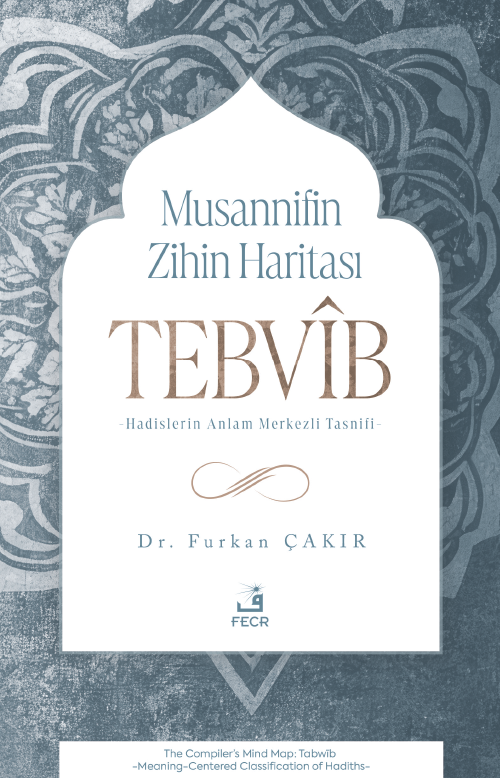
The Compiler’s Mind Map
Tabwīb
– Meaning-Centered Classification of Hadiths –
This study examines the phenomenon of tabwīb, which is associated
with the transformation of hadiths from being merely tools of transmission
into primary sources of meaning, legal judgment, and social
orientation throughout history. In the developmental trajectory of hadith
scholarship, the first stage, tadwīn, responded to the need for preserving
knowledge by recording narrations that had previously existed
in memory or scattered written notes. The subsequent taṣnīf period organized
these narrations thematically, placing concepts such as kitāb,
bāb, and tarjama at the center of the scholarly tradition. As al-Dhahabī
aptly pointed out, tabwīb, like taṣnīf and tadwīn, should be regarded as
an independent stage in the evolution of hadith literature. In this context,
tabwīb represents more than a formal method of classification; it
reflects the compiler’s intellectual perspective, the intellectual climate
of his time, and his methodological preferences. The study emphasizes
the necessity of renewing (tajdīd) tabwīb in order to preserve the timeless
message of the Prophet’s traditions. Based on the principle that
the texts (naṣṣ) are limited while events are infinite, it argues that the
semantic framework of the hadith tradition draws not only from textual
content but also from the historical context of bāb headings. Accordingly,
attempts to reconstruct the hadith corpus must be approached with
scholarly precision and conceptual integrity so as to preserve continuity
with the classical tradition.
Keywords: Hadith; Tabwīb; Tadwin; Tasnif; Tajdid

 İÇ SAYFALAR