0 Items - ₺0,00
- Sepette hiç bir ürün yok.

Orijinal fiyat: ₺330,00.₺230,00Şu andaki fiyat: ₺230,00.
 İÇ SAYFALAR
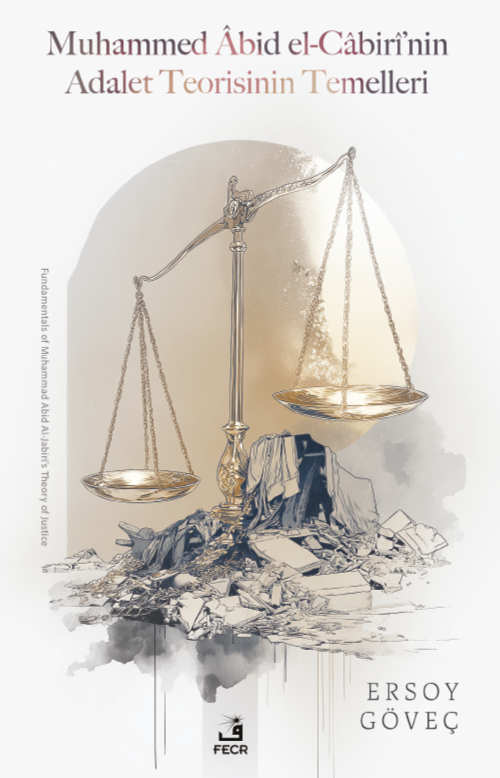
Fundamentals of Muhammad Abid Al-Jabiri’s Theory of Justice
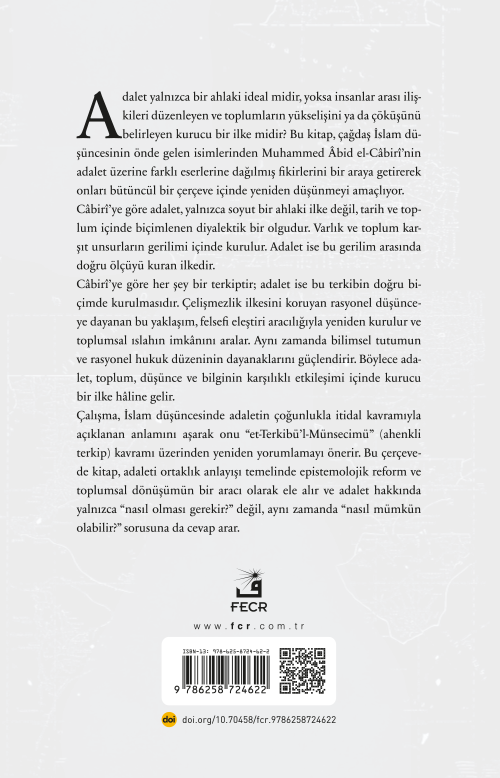
The book examines Câbirî’s understanding of justice within a theoretical
framework. It proposes to translate the conceptual and semantic structure
of justice in Islamic thought, built upon the principle of moderation
(i‘tidāl), into a coherent framework. The work aims to respond to the
political, social, and intellectual crises experienced in the Arab-Islamic
world through a theory of justice. Accordingly, the theory of justice
gains significance within the broader project of societal reconstruction.
Câbirî adopts Galen’s principle of “right composition” as a foundational
guideline, developing a justice model based on a dialectical synthesis
that reconciles opposites. Within this framework, Plato’s understanding
of social values and Aristotle’s principle of moderation are critically
reinterpreted in relation to modern philosophy and scientific thought.
Justice is grounded as a constitutive and holistic principle that structures
both political and social order, and it is further developed on the
basis of political reasoning and the societal principle of ‘asabiyyah. The
theory can also be assessed in relation to modern claims of citizenship.
In this context, justice is first defined as the harmonious composition of
social structures, and second, as the balance and equilibrium achieved
in interpersonal rights and duties. It is presented as a fundamental condition
for democratic political order and social legitimacy. Economic
justice is conceptualized through a critique of structures centered on
political rent and the defense of social relations based on labor and
production, situating economic factors as foundational to societal transformation.
Finally, justice is re-envisioned as a transformative principle
grounded in right composition, extending beyond moral moderation to
a scientifically informed and reformative framework.
Keywords: al-Jâbirî; Justice; Dialectical Synthesis; ‘Asabiyyah; Political
Rent
| Genel Yayın No | 1874 |
|---|---|
| Marka | Fecr |
| Marka No | 1106 |
| ISBN | 9786258724622 |
| Yayım Tarihi | 23.03.2026 |
| Dil | |
| Boyut | 13,5 x 21 cm |
| Baskı Sayısı | 1 |
| Sayfa Sayısı | 269 |
| Kağıt Cinsi | 60 gr. Enzo |
| Kapak |