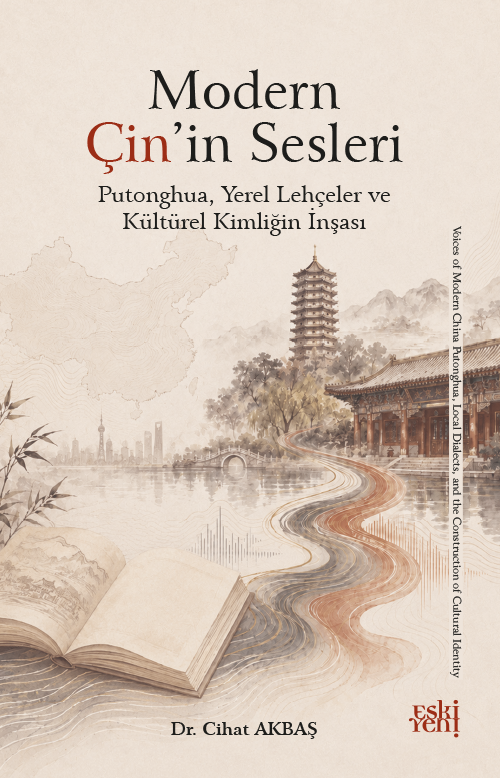
Voices of Modern China
Putonghua, Local Dialects, and the Construction of
Cultural Identity
This book examines the relationship between language, identity, and
nation-building in modern Chinese society through the rise of Putonghua
and the transformation of local dialects. Its central premise is
that a modern nation should be understood not only through political
institutions, economic development, or cultural heritage, but also
through the voices that are legitimized in public life. In this framework,
Putonghua is analyzed as the common public language of modern China,
extending across education, state administration, media, urban life,
labor markets, and digital platforms. Yet the book does not treat this
process as a simple story of standardization or the disappearance of local
speech. Cantonese, Shanghainese, Hokkien, Hakka, Wu, Gan, Xiang,
Jin, and other regional speech forms are discussed in relation to family
memory, regional belonging, humor, popular culture, migration, media
representation, and digital visibility. Bringing together sociolinguistics,
language policy, cultural studies, and China studies, the book explores
how the standard language functions as linguistic capital and how it
shapes citizenship, mobility, social hierarchy, and access to public institutions.
At the same time, it argues that local dialects are not merely
residual or folkloric elements of the past, but living cultural domains
that carry the multilayered and polyphonic character of Chinese identity.
The book therefore proposes reading China not as a monolingual
national narrative, but as a dynamic field of tension, complementarity,
and transformation between Putonghua and local voices.
Keywords: Putonghua; Standard Mandarin; local dialects; Fangyan;
Chinese language policy; language and identity; cultural memory; linguistic
capital; modern China; sociolinguistics

 İÇ SAYFALAR