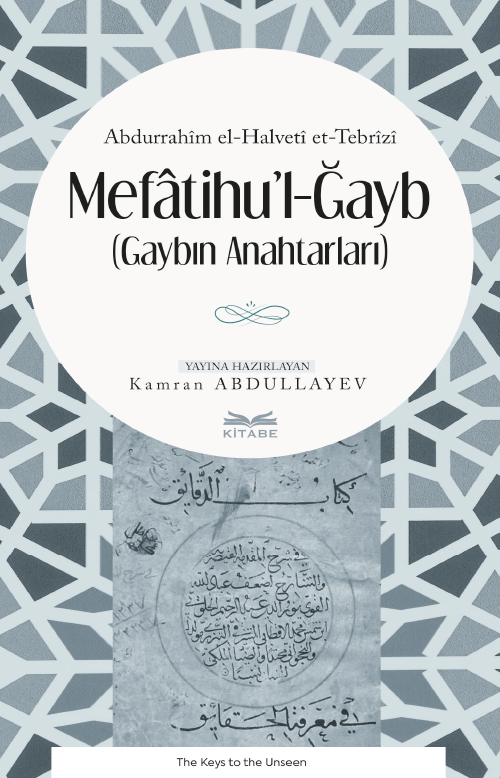
The Keys to the Unseen
Abdurrahim Halvetî is one of the rare personalities nurtured by the
geography of Azerbaijan in the 15th century. Originally from Nakhchivan
but having lived in Tabriz, the capital of Southern Azerbaijan,
Halvetî skillfully harmonized the artistic and scientific accumulation
of both cities. He received his training in the Six Scripts of Calligraphy
(Aklâm-ı Sitte) from his father, Şemseddin Aktâbî, and benefited
from some of the most famous Sufi Shaykhs of his era, including Şirini
Mağribî, Zeyneddin Havâfî, and Ali es-Safevî.
Halvetî demonstrated his mastery in calligraphy through the Qur’an
manuscript (Mushaf) he penned for the library of the Akkoyunlu ruler
Uzun Hasan. Furthermore, his various Sufi treatises, such as Kitâbuʼd-
Dekâik fî Marifetiʼl-Hakâik, Tezkire, and Şerhuʼn-Nusûs fî Tahkîkiʼt-
Tavriʼl-Mahsûs, clearly denote his affiliation with the Akbari school,
aligning with the philosophical lineage of Ibn Arabî, Sadreddin Konevî,
and Davud Kayserî. He also exhibited his poetic talents in both languages
through his Persian Divan, Mefâtihuʼl-Ğayb, and numerous Arabic
poems found in his other works.
It is noteworthy, however, that this significant figure, the author of an
extensive body of work, has been the subject of very few academic
studies since his passing. Information concerning Halvetî’s biography
remains considerably limited, and a substantial number of his works
have yet to be located. It is the necessity to introduce and shed light
on this crucial figure that motivates the initiation of this study, focusing
on his work, Mefâtihuʼl-Ğayb.
In the introductory section of the study, an attempt has been made to
reconstruct Halvetî’s biography by examining his life and works using
the available sources, culminating in a presented list of his manuscripts.
Despite all efforts, the current whereabouts of many of Halvetî’s
literary works remain unknown. The second part of the study is
dedicated to the critical edition (tahkik) of Mefâtihuʼl-Ğayb, based on
the two extant manuscripts accessible to us. Given that the author’s
own manuscript could not be found and the current copies contain
numerous scribal errors, the critical editing process did not rely on a
single source. Instead, the full, established text was compiled by correcting
errors found across both manuscripts.
Keywords: Khalwati, Tabriz, Nakhchivan, Mefâtihuʼl-Ğayb, Tasawwuf,
Arabic.

 İÇ SAYFALAR