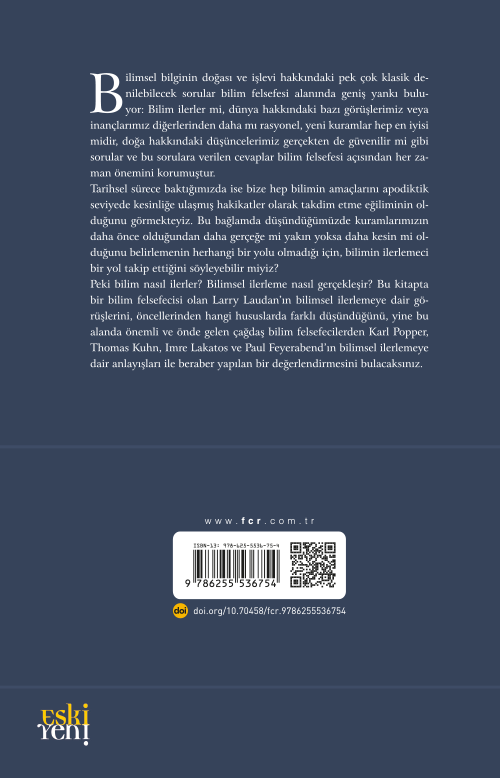
This study addresses scientific progress, which has an important place
in terms of the history and philosophy of science and has been one
of the prominent issues regarding the nature of knowledge in recent
centuries. It attempts to outline how scientific progress is generally
addressed by contemporary philosophers of science, and in particular
Larry Laudan’s understanding of scientific progress, based on his work
Progress and Its Problems. Laudan’s understanding of theory, his definition
and classification of scientific problems, and the basic views of the
model he proposed for the formation of a theory of scientific progress
come to the fore. In other words, Laudan, who argues that the only
cognitive purpose of science in the most general sense is problem-solving,
shows how the nature of scientific progress can be addressed in a
completely useful way in terms of problem-solving, which is a problem-
centered model. Accordingly, rationality and scientific progress are
not equivalent to each other, and both concepts should be distinguished
from each other. He wants to change the general view that sees progress
as approximation in itself and gradually reaching accuracy over time
in a self-correcting process. Laudan attempts to completely change this
general understanding by showing that rationality was formed by being
added to progressivism later on. Laudan, while developing this model
of the theory of progress, which he calls research traditions, on the one
hand, towards becoming a theory of progress, on the other hand, brings
the concept of progress to the agenda by showing the deficiencies and
problems of different conceptual frameworks such as Kuhn’s paradigm
and Lakatos’ scientific research program methodology, which are contemporary
with him, and the theories of progress proposed by these
frameworks.
Keywords: Larry Laudan; Research traditions; Science; Scientific; Scientific
progress


 İÇ SAYFALAR