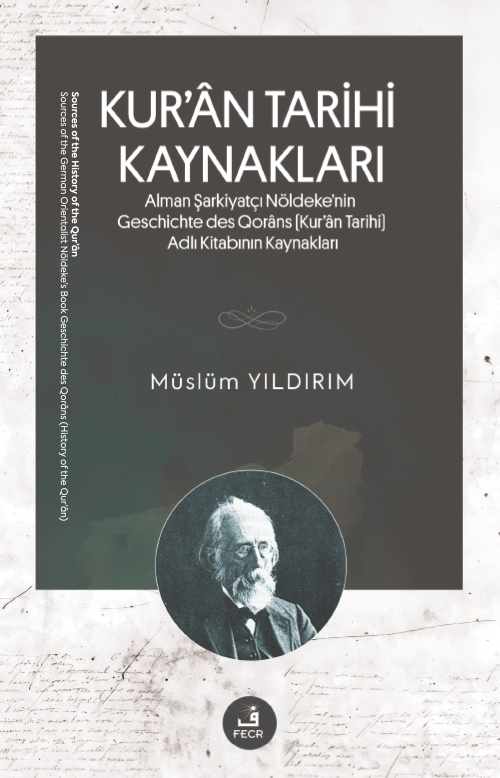
Sources of The History of the Qur’ân
Sources of the German Orientalist Nöldeke’s Book
Geschichte des Qorâns (History of the Qur’ân)
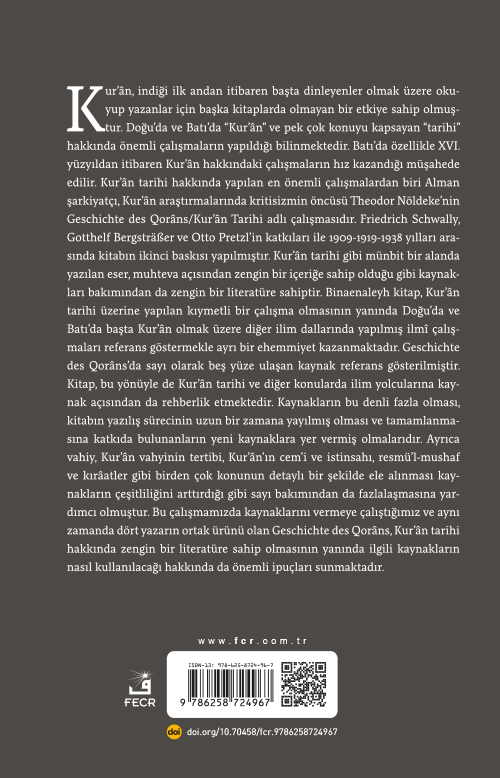
Geschichte des Qorâns is a book on the history of the Qur’ân written
by Theodor Nöldeke and completed over a period approaching a
century through the contributions of Friedrich Schwally, Gotthelf
Bergsträßer and Otto Pretzl, scholars belonging to the Nöldeke
school. All three authors contributed not only to the content of the
work but also enriched it through the wide range of sources they incorporated.
This study examines the extensive body of sources cited
in Geschichte des Qorâns, numbering close to five hundred. The
principal source of our research is the second edition of Geschichte
des Qorâns (Leipzig: Dieterich’sche Verlagsbuchhandlung, 1909-
1919-1938), completed through the contributions of Nöldeke and
the three aforementioned scholars. Besides consulting the first
edition of the book, published by Nöldeke in 1860, this study also
draws upon the works of Bergsträßer and Pretzl, whose scholarly
contributions to the Qur’ân and the qirâʾât include significant
critical editions and original research. With a few exceptions, all
of the sources mentioned in this study were consulted, and nearly
all of the articles that constitute an important part of the book’s
references were also accessed. While preparing this study, we additionally
referred to works published after the appearance of the
three volume edition in 1938. The study consists of an introduction
and two chapters. The first chapter examines Islamic sources, while
the second chapter deals with Western sources. Under the category
of Islamic sources, manuscript copies of the Qur’ân preserved
in museums and libraries, particularly in Istanbul, Berlin, Gotha
and several other cities, are discussed. Furthermore, the sources
of Geschichte des Qorâns are presented under the headings of
Qur’ânic exegesis (tafsîr), Qur’ânic sciences (ʿulūm al-Qurʾân), hadith,
prophetic biography (sîra), history, biographical literature
(ṭabaqât), geography, bibliography, lexicography, grammar, general
viii
culture, literature, dictionaries, Islamic jurisprudence (fiqh), creed
(ʿaqâʾid), ethics, and polemical refutations. Both manuscript and
printed editions of some of these sources have been examined. In
the second chapter, under the general heading of Western sources,
the books and a significant number of article references cited in
Geschichte des Qorâns are presented. These include works on, foremost,
the Bible and the Talmud, as well as studies on the Qur’ân and
hadith, sîra and history, linguistics, literature, paleography, travel
accounts, memoirs, and various other subjects. With the exception
of one or two minor errors, it may generally be said that quotations
in Geschichte des Qorâns have been cited accurately, information
has been presented objectively, and sources have been used effectively.
Geschichte des Qorâns served as a pioneering work for later
research in the West, especially in Germany, on the Qur’ân, linguistics,
and other related fields, and it has left behind a rich treasury
of sources for subsequent scholarship.
Keywords: Tafsîr; History of the Qur’ân; Mushaf; Orientalism;
Nöldeke; Geschichte des Qorâns; Sources

 İÇ SAYFALAR