0 Items - ₺0,00
- Sepette hiç bir ürün yok.

Orijinal fiyat: ₺375,00.₺260,00Şu andaki fiyat: ₺260,00.
 İÇ SAYFALAR
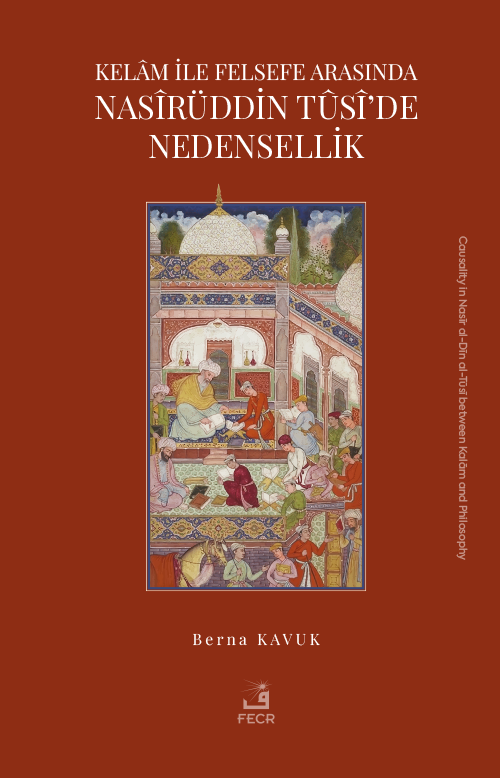
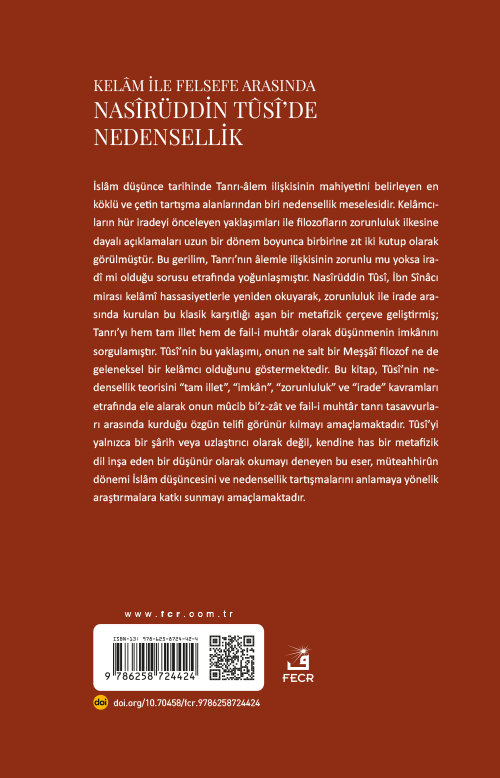
Causality in Nasīr al-Dīn al-Tūsī between Kalām and Philosophy
This study examines the concept of causality from a metaphysical perspective
in the thought of Nasīr al-Dīn al-Tūsī, one of the prominent
representatives of the thirteenth century, a period in which kalam and
philosophical thought were largely synthesized. It explores how Tūsī’s
views on God’s act of creating the world reflect both kalam and philosophical
traces, how he evaluates both approaches through a critical
lens, and the originality of the conclusions he reaches. In this context, all
of Tūsī’s Works -particularly Tajrīd al-‘aqāid, Sharh al-Ishārāt wa’l-tanbīhāt
and Talkhīs al-Muhassal- have been examined. His views are interpreted
in light of the intended purpose underlying the composition of
his works. The concept of causality is discussed within the framework of
ontology and theology. Within the scope of this research, several fundamental
aspects of the problem of causality are addressed: the classification
of beings that constitute the essence of the issue, the nature of the
relationship established between necessary and possible existence, the
position of quiddities in relation to the efficient cause, and the doctrine
of emanation (sudur). Tūsī’s analyses of the possibility of the many emanating
from the One, as well as his evaluations concerning the problem
of infinite regress (tasalsul), are also discussed. Furthermore, the role
and function of the divine essence and attributes within the causal order,
along with reflections of causality on various conceptions of God,
are examined in relation to theological issues. Taking into account the
criticisms directed at earlier approaches to the God-world relationship,
Tūsī attempts to ascribe the eternal world to a volitional agent (al-fā‘il
al-mukhtār). By considering divine will as a component of the complete
cause (al-‘illa al-tamma), he grounds the eternity of the world in this
will. He remains committed to the principle that “only one proceeds
from the One,” explaining multiplicity in terms of aspects and relational
considerations. His statements that the number of supralunar beings
lacks certainty and should be understood symbolically represent a contribution
to the doctrine of emanation. Moreover, he rejects the view
that divine knowledge is the source of the necessity of emanation, placvii
ing divine will at the center of his understanding of causality. In these
respects, Tūsī’s conception of causality may be considered an original
example that interprets the God-world relationship through the lens of
both necessity and will, combining philosophical heritage with kalamic
sensibility.
Keywords: Kalam; Nasīr al-Dīn al-Tūsī; Causality; Cause; Effect
| Genel Yayın No | 1833 |
|---|---|
| Marka | Fecr |
| Marka No | 1087 |
| ISBN | 9786258724424 |
| Yayım Tarihi | 11.02.2026 |
| Dil | |
| Boyut | 13,5 x 21 cm |
| Baskı Sayısı | 1 |
| Sayfa Sayısı | 291 |
| Kağıt Cinsi | 70 gr. Enzo |
| Kapak |