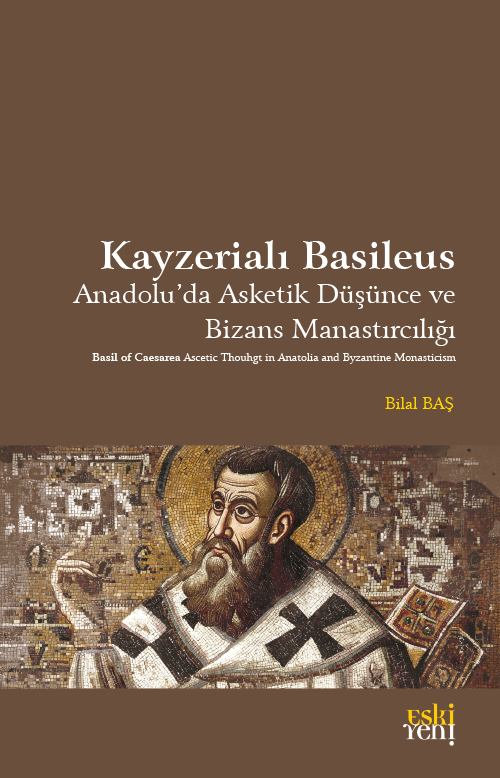
Basil of Caesarea
Ascetic Thouhgt in Anatolia and Byzantine Monasticism
The present study tells the story of how the ascetic way of life in
fourth-century Anatolia was transformed into monasticism, focusing
on the thought and actions of its central figure, Basil of Caesarea
(330–379). This century was also the period when Christianity, once
a forbidden underground religion, was made the religion of the Roman
Empire by Emperor Constantine (d. 337) and his successors. For
this reason, the story of monasticism is also closely tied to politics.
Powerful bishops such as Basil played a key role in shaping this symbiosis
between Church and Empire. To this end, the aim was to create
a universal Church unity. This meant establishing an official stance on
doctrinal matters, thereby forming an orthodox system of belief, while
also setting the standard for religious life. The Arian controversy served
as the catalyst for doctrinal unity; the ascetic lifestyle functioned as the
catalyst for unity in practice. Basil was a towering figure who played
a vital role in both areas. In the Arian controversy, he and his close
associates formulated the doctrine that became official at the Council of
Constantinople in 381. Likewise, the standard for acceptable Christian
piety was defined by monastic life, articulated through the rules Basil
himself wrote. Consequently, Basil came to be regarded as the founder
of all Byzantine monastic tradition, and his legacy has endured to the
present day. The defining feature of his monastic vision was a model
of urban monasticism, where monks lived among the people and were
devoted to charitable service. The aim of this book is to reveal how
Basil, out of various alternatives, constructed this standard conception
of asceticism.
Keywords: Basil of Caesarea; Byzantine monasticism; asceticism; Eustathius
of Sebastea; Messalianism; Arianizm; Cappadocia

 İÇ SAYFALAR