1000₺ ve üzeri alışverişlerde ÜCRETSİZ KARGO
Hafta içi saat 12.00‘ye kadar verilen siparişler AYNI GÜN KARGODA

  • 0 Items - 0,00
    • Sepette hiç bir ürün yok.
-30%YENİ

Orijinal fiyat: ₺200,00.Şu andaki fiyat: ₺140,00.

İlk Dönem İslam Tarihinde Bedevi Zihniyeti ve Yansımaları

The Bedouin Mindset and Its Reflections in Early Islamic History

10.70458/fcr.9786258724998

0009-0009-9175-3641 F1143 , Bu kitap 1 adet satın alınmıştır.
Paylaş


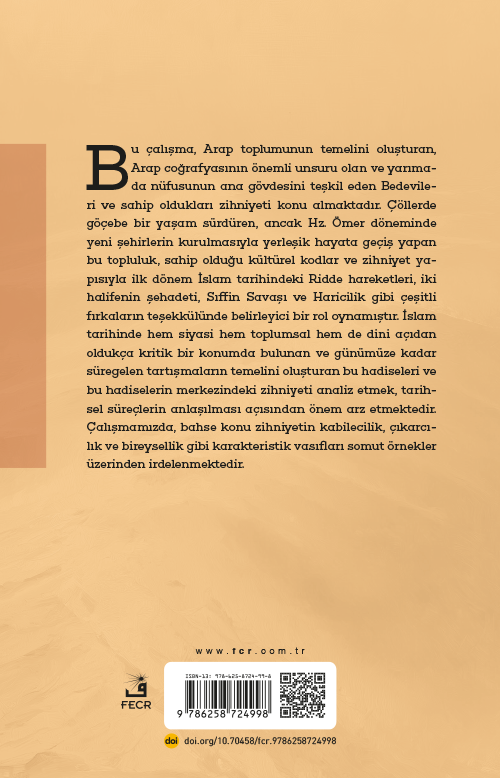
İslam tarihinde siyasi, sosyal ve dinî hadiselerin doğru bir şekilde okunması ve bu okuma sırasında olayların merkezinde yer alan şahısların sosyo-psikolojik yapılarının iyi bilinmesi son derece önem arz etmektedir. İslam Tarihi alanında okumalar yaptığımızda sıkça gördüğümüz kavramlardan biri olan “bedevi”, neredeyse ilk dönem İslam tarihinde meydana gelen birçok olayın merkezinde yer almaktadır. Durum böyle olunca bedevinin sosyo-psikolojik yapısını yani bedevi zihniyetini bilmek son derece önem arz etmektedir. Zira bu zihniyet; kabilecilik, bireyselcilik, pragmatizm ve düşüncede yüzeysellik gibi karakteristik vasıflarıyla ilk dönem İslam tarihinin şekillenmesinde ve sonraki dönemlere tevarüs eden siyasi- dinî anlayışların zemin bulmasında ya doğrudan ya da dolaylı yoldan etkili olmuştur. Bu çalışmada, Hz. Peygamber ve Dört Halife dönemindeki siyasi, sosyal ve dinî hadiselerin arkasındaki itici güçlerden biri olan bedevi zihniyeti tarihî süreç içerisinde ele alınmış; bu zihniyetin karakteristik özellikleri ile bu özelliklerin tarihsel kırılma noktalarındaki tezahürleri incelenmiştir. Bu çerçevede; Ridde Hareketleri, Hz. Osman’ın şehadeti, Sıffîn Savaşı ve Hariciliğin doğuşu başta olmak üzere İslam toplumunu sarsan büyük hadiseler, bedevi zihniyeti üzerinden değerlendirilmiştir. Bunun yanında, bedevi kabilelerin İslam’ın yayılma sürecinde askerî bir güç olarak oynadıkları rol ile merkezî otoriteye karşı sergiledikleri direnç arasındaki paradoksal ilişki ele alınmıştır. Araştırmada, başta klasik İslam tarihi kaynakları, tefsir ve hadis literatürü olmak üzere konuya dair temel eserlerden istifade edilmiş olup rivayetler, tarihî bağlamı, dönemin şartları ve sosyolojik değer yargıları dikkate alınarak değerlendirilmiştir. Elde edilen veriler, bedeviliğin, yalnızca fiziksel bir göçebelik veya mekânsal bir durum olarak açıklanamayacağını; aksine mekândan bağımsız bir “zihinsel durum” olarak şehir hayatında ve siyasi kurumlarda da varlığını sürdürdüğünü göstermektedir. Dolayısıyla ilgili dönemde bedevi zihniyetinin yansımalarının incelenmesi hem İslam medeniyetinin dil ve kültür sahasındaki teşekkül sürecinin hem de bugün hâlâ devam eden pek çok tartışmanın kökenini teşkil eden Arap zihniyetinin daha doğru anlaşılmasına önemli katkılar sunmaktadır.
Anahtar Kelimeler: İslam Tarihi; Hz. Peygamber; Cahiliye; Bedevi; Bedevi Zihniyeti.

 İÇ SAYFALAR
The Bedouin Mindset and Its Reflections in Early Islamic History
-The Case of the Prophet and the Four (Rashidun) Caliphate-
It is very important to correctly read the political, social and religious
events in the history of Islam and to know, during this reading,
the socio-psychological structures of the individuals who are
at the center of these events. The term “Bedouin”, which is one of
the concepts we frequently see when reading Islamic history, lies
at the center of many events that occurred during the Early Islamic
Period. In the circumstances, understanding the sociopsychological
structure of the Bedouin, namely, the Bedouin
mindset, becomes extremely important.
This mindset, with its characteristic features such as tribalism,
individualism, pragmatism, and superficiality in thought, has either
directly or indirectly influenced the shaping of Early Islamic
History and provided a foundation for the political-religious understandings
inherited by subsequent periods.
In this study, the bedouin mindset, which is one of the driving
forces behind the political, social, religious events during the period
of Prophet and the Four (Rashidun) Caliphate, is examined
within its historical process. It also analyzes the characteristic
features of this mindset as well as their appearances at historical
breaking points.
Within this framework, major events that shook Islamic society,
particularly the Ridda (apostasy) movements, the martyrdom of
Uthman, the Battle of Siffin, and the emergence of Kharijism, are
evaluated through the Bedouin mindset.
Besides this, the study addresses the contradictory relationship
between the role Bedouin tribes played as a military force in the
expansion of Islam and the resistance they displayed against central
authority.
During the research, primary sources on the subject, particularly
classical Islamic history sources, exegesis (tafsir), and hadith litviii
erature, are utilized. Narratives are evaluated by taking into account
their historical context, the conditions of the period, and
sociological value judgments.
The data obtained indicates that Bedouinism cannot be explained
merely as physical nomadism or a spatial condition. On the contrary,
it persists as a space-independent “state of mind” within
urban life and political institutions.
Now, therefore, analyzing the reflections of the bedouin mindset
in the relevant period provides important contributions to a more
accurate understanding ofboth the formation process of Islamic
civilization in the fields of language and culture, and the Arab
mindset, which
Keywords: Islamic History; The Prophet; Jahiliyyah; Bedouin;
Bedouin Mindset.

Genel Yayın No

1966

Marka

Fecr

Marka No

1143

ISBN

9786258724998

Yayım Tarihi

24.07.2026

Dil

Boyut

13,5 x 21 cm

Baskı Sayısı

1

Sayfa Sayısı

127

Kağıt Cinsi

70 gr. Enzo

Kapak

Taksitleri Güncelle