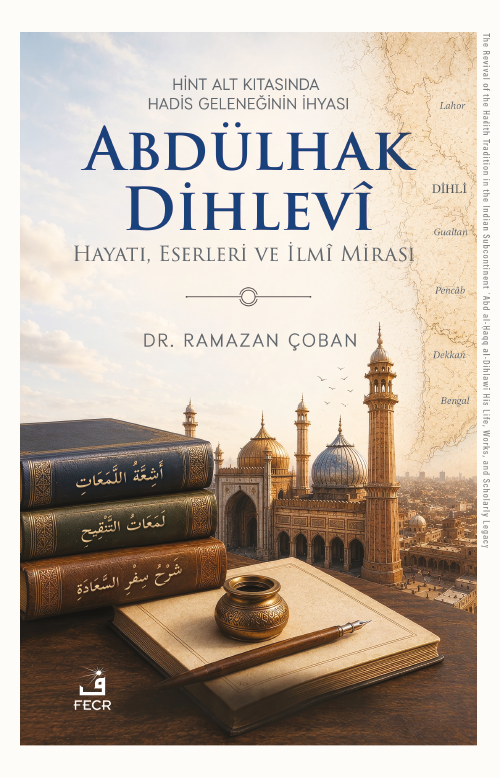
The Revival of the Hadith Tradition in the Indian Subcontinent
ʿAbd al-Ḥaqq al-Dihlawī His Life, Works, and Scholarly Legacy
Since the 9th/15th century, a remarkable revival has taken place in the field of Hadith
studies in the Indian Subcontinent. Hadith education, institutionalized through the widespread
network of madrasas in the region, has continued up to the present day. One of
the leading figures of this revival was Abū al-Majd ʿAbd al-Ḥaqq b. Sayf al-Dīn al-Bukhārī
al-Dihlawī (958–1052/1551–1642). Considering his significant role in revitalizing Hadith
scholarship through both his writings and his students, it is important to introduce ʿAbd
al-Ḥaqq al-Dihlawī and to determine the contributions of his works to the science of Hadith.
Born and raised in Delhi, ʿAbd al-Ḥaqq al-Dihlawī attended the study circle of ʿAbd al-Wahhāb
al-Muttaqī in Mecca between 996–999/1588–1590 and transmitted the Hadith knowledge
he acquired there to his homeland. Devoting fifty-two years of his ninety-four-year
life to the teaching and transmission of Hadith in Delhi, he played a pioneering role in the
dissemination of Hadith scholarship throughout the region. He authored approximately
sixty works, some of which were devoted to Hadith studies. He wrote a commentary
entitled al-Ṭarīq al-Qawīm fī Sharḥ al-Ṣirāṭ al-Mustaqīm on al-Fīrūzābādī’s Sifr al-Saʿāda
and contributed to the Hadith commentary tradition through his Persian commentary
Ashiʿat al-Lamaʿāt and his Arabic commentary Lamaʿāt al-Tanqīḥ on al-Khaṭīb al-Tabrīzī’s
Mishkāt al-Maṣābīḥ. In addition, in his work Fatḥ al-Raḥmān fī Ithbāt Madhhab al-Nuʿmān,
he commented on legal Hadiths, thereby bringing together Hadith and Islamic jurisprudence.
This study examines the life, works, and historical context of ʿAbd al-Ḥaqq al-Dihlawī
and seeks to identify his contributions to Hadith scholarship, Hadith methodology, the
literature of Hadith commentary, and the Ḥanafī understanding of Hadith. Furthermore,
the network of Hadith transmission licenses (ijāzāt) has been reconstructed through an
analysis of his chains of transmission. Lamaʿāt al-Tanqīḥ, regarded as his most important
work in Hadith scholarship, has been examined with respect to its commentary methodology,
textual analysis, and interpretation of narrations. It has also been compared
with earlier commentaries on Mishkāt al-Maṣābīḥ in order to identify its distinctive features
and evaluate its influence on subsequent commentaries. Employing literature review
and descriptive analysis methods, the study concludes that al-Dihlawī defended the
Ḥanafī understanding of Hadith, interpreted Hadiths from a Sufi perspective, and contributed
to the dissemination of Hadith methodology in the region by providing concise
discussions of its principles. However, it also demonstrates that he did not introduce a
novel methodological approach to Hadith studies, but rather continued the established
scholarly tradition.
Keywords: Hadith, Indian Subcontinent; ʿAbd al-Ḥaqq Dihlawī; Mishkāt


 İÇ SAYFALAR