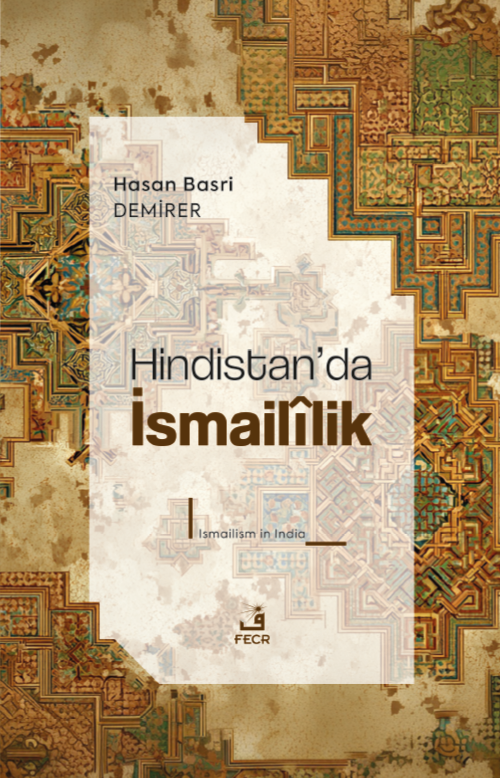
This Ismailism in India
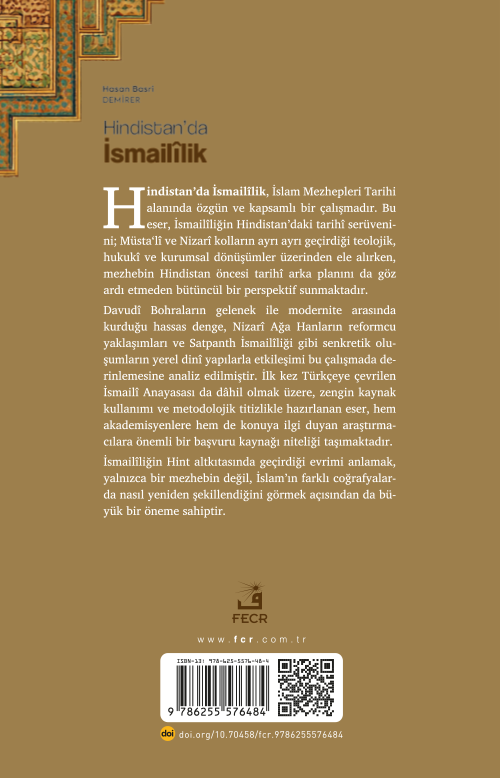
This study examines the Ismaili movement in India from historical, theological,
and juridical perspectives, analyzing the formation and development
processes of the Musta’li and Nizari Ismaili communities. The
research broadly explores the historical trajectory of Ismailism prior
to its arrival in India and the transformations experienced by Ismaili
communities in the region.
The first chapter provides a historical background on Ismailism in India.
It discusses the emergence of the sect, the subsequent period of
clandestine da’wa (missionary activity), the Fatimid era, and the Musta’li-
Nizari schism. This section highlights how this division led to both
political and theological transformations within the Ismaili movement.
Additionally, it examines the Nizari Ismailis during the Alamut period,
their reorganization following the Mongol invasions, and their eventual
expansion into India.
The second chapter focuses on Musta’li Ismailism in India. It first traces
the arrival of the Musta’li branch in the region and the subsequent split
into the Da’udi and Sulaymani Bohra communities. The chapter also
discusses how the Da’udi Bohras have maintained a balance between
traditional and contemporary elements in their process of modernization.
In this context, the doctrinal and juridical perspectives of the community,
its hierarchical religious structure, and its contemporary status
are examined in detail.
The third chapter is dedicated to Nizari Ismailism in India. It explores
the arrival of the Nizaris in the region, their early missionary efforts,
and their relationship with the Khoja community. Subsequently, the
chapter analyzes the modern transformation of Nizari Ismailism under
the leadership of the Aga Khans, as well as the current structure
of the community, including its doctrinal and juridical views. The socio-
economic and cultural reforms introduced by the Aga Khans and
the organizational structure of the Nizari community are also examined
comprehensively.
The conclusion assesses the relationship between the historical roots
and modern identities of the Ismaili communities in India, discussing
the role of Ismailism in contemporary Indian society. Due to its significance
for the presentday Aga Khan community, a translation of the Ismaili
Constitution is appended to the study. By analyzing the historical
development of Ismailism within a regional framework, this study aims
to contribute to an understanding of the evolution of the sect in India.
Keywords: India; Ismailism; Musta’lism; Nizarism; Bohra; Aga Khan

 İÇ SAYFALAR