Migration Integration and Religion
Turks in France
Migration is accepted as a social phenomenon as old as human history. Throughout their
life journey, human beings have migrated sometimes individually, sometimes as families,
and sometimes collectively as societies. Migrations that have taken place throughout
history have occurred for many different reasons. When these migration events are examined,
factors such as wars, famines, and the concern for earning a livelihood appear
as primary causes. Citizens of the Republic of Türkiye have also migrated from Türkiye
to France and other European countries since the mid-twentieth century in order to find
jobs and sustain their livelihoods.
In the early 1960s, within the framework of labor agreements made with some European
countries, citizens of the Republic of Türkiye went to these countries to work as temporary
laborers. Following the initial migrations, although the official transfer of workers
continued for a certain period, it later proceeded through illegal means. Meanwhile, as
labor migration continued through different channels, the first migrants came to realize,
after working for 5–10 years, that returning to Türkiye was no longer feasible. Consequently,
through family reunification, they began to bring their spouses and children
to the European countries where they resided. As a result of this mobility, a Turkish
population in Europe—eventually reaching into the millions—emerged over the years.
This social formation began to attract the attention of many academic disciplines such
as sociology, psychology, education, economics, and political science. Since the initial migrations
were carried out under labor agreements that anticipated eventual return, no
preparation had been made regarding how these workers—who would live as minorities
in the host countries—would meet their spiritual needs, particularly in practicing
their religion. This situation created challenges for Muslim Turks who became permanent
residents in Europe. In this context, the issues faced by Muslim Turks in practicing
their religious beliefs, as well as their religiously oriented socio-cultural problems from
the beginning to the present, have become a subject worthy of sociological examination.
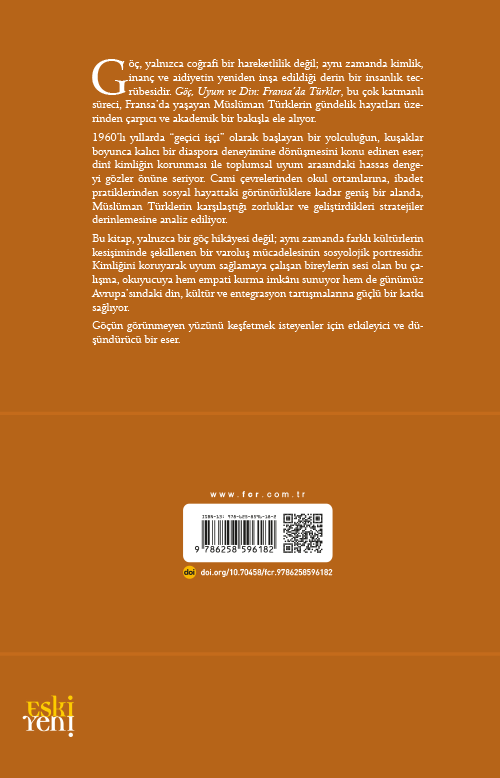
This study, consisting of an introduction and two chapters, examines the life experiences
of a Muslim minority community striving to adapt to a foreign society while preserving
its religious identity. In the first chapter, key concepts related to the subject—such
as identity, integration, racism, Islamophobia, religion, and family—are evaluated. In
the second chapter, the religious experiences of the Muslim Turkish community within
French social spaces and in diaspora areas formed around mosques are analyzed under
various themes such as prayer, headscarf, and clothing. In this context, the possibilities
of achieving integration while preserving identity are discussed.
Keywords: Religion; Religious Practices; Identity; Integration; Muslim Turks


 İÇ SAYFALAR