0 Items - ₺0,00
- Sepette hiç bir ürün yok.

Orijinal fiyat: ₺600,00.₺420,00Şu andaki fiyat: ₺420,00.
 İÇ SAYFALAR
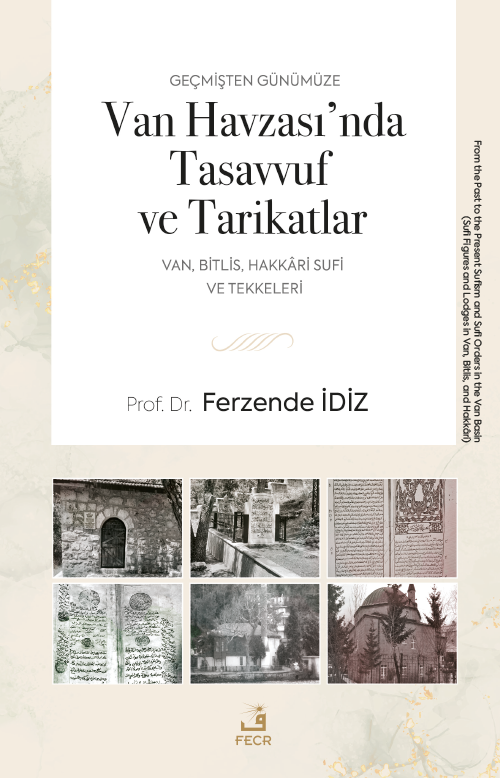
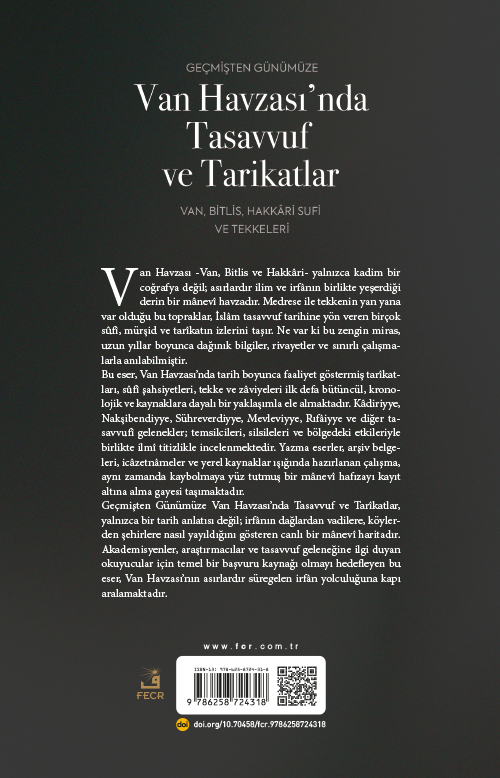
This work examines the Sufi orders (ṭarīqas), Sufi figures, and Sufi institutions that have
been active throughout history in the Van Basin-an exceptional center within Anatolia’s
geography of wisdom (irfān)-encompassing Van, Bitlis, and Hakkâri. The study initially
focused on Van; however, with the recognition that the spiritual fabric of the region cannot
be understood independently of Bitlis and Hakkâri, a holistic basin-based perspective
was adopted. Indeed, the desire and aspiration to disseminate the tradition of service
and spiritual wisdom to all people and across all geographies were never confined to the
place of origin. Accordingly, as in other regions, the spiritual influence of a guide (murshid)
serving in this geography was not limited to a single locality but resonated across
mountains and found echoes in neighboring cities. It is therefore not possible to consider
Van and Bitlis apart from Hakkâri, nor Hakkâri apart from these regions.
The Van Basin encountered Islam at an early period, and the traditions of the madrasa
and the tekke served for centuries as carriers of knowledge (‘ilm) and spiritual wisdom
(irfān) in these lands. Despite this, the absence to date of a systematic, source-based, and
comprehensive academic study on the Sufi orders, Sufis, and tekkes that operated in the
region constitutes a significant scholarly gap. The present work aims to fill this void by
recording, on an academic basis, information that has largely remained scattered within
oral culture, manuscripts, archival documents, and local memory.
During the research process, it became evident that many written sources related to Van
were lost due to wars, occupations, and periods of oppression, whereas Bitlis and Hakkâri
offer relatively richer archival materials. This circumstance directly influenced both the
methodology of the study and the use of sources.
The book consists of three main sections. The first section addresses Van, the second Bitlis,
and the third Hakkâri. In each section, after presenting the historical background of
the respective province, Sufi figures are examined chronologically within the framework
of their affiliated Sufi orders. Those whose ṭarīqa affiliation could not be identified are
discussed under the heading “Affiliation Unknown” within the relevant provincial section.
In addition, information is provided on tekkes and zāwiyas established in these
provinces throughout history, some of which have not survived to the present day.
This book approaches the Sufi history of the Van Basin not merely as a narrative of the
past, but as a living heritage of irfān that continues to illuminate the present and the future.
Prepared on the basis of compilations, archival documents, manuscript research, and local
sources and interviews, this work-by virtue of being a pioneering study-aims to serve
as a foundation and a guiding reference for future academic research.
Keywords: Sufism; Tariqa; Sufi; Van; Hakkâri; Bitlis; Naqshbandiyya; Qadiriyya; Suhrawardiyya;
Nurbakhshiyya; Safaviyya; Zawiya; Nehri; Gayda; Norshin; Ohin
| Genel Yayın No | 1819 |
|---|---|
| Marka | Fecr |
| Marka No | 1076 |
| ISBN | 9786258724318 |
| Yayım Tarihi | 17.01.2026 |
| Dil | |
| Boyut | 16 x 24 cm |
| Baskı Sayısı | 1 |
| Sayfa Sayısı | 429 |
| Kağıt Cinsi | 70gr. Enzo (Renkli Baskı) |
| Kapak |