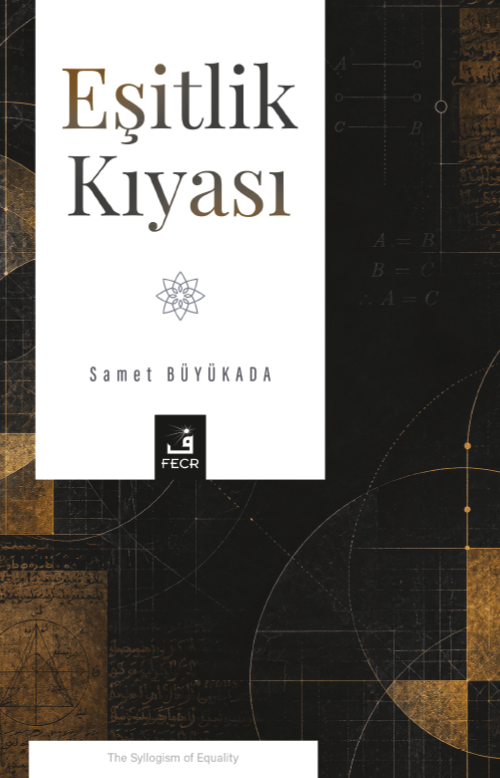
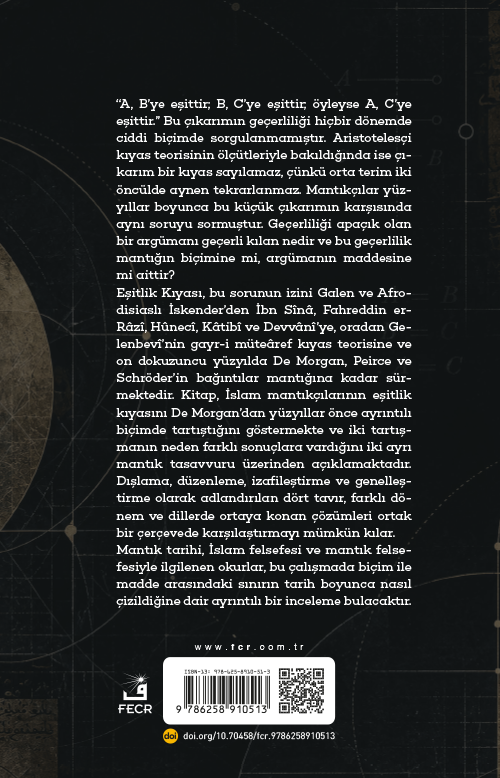
This book examines the career of the inference “A is equal to B; B
is equal to C; therefore A is equal to C” in the history of logic. Although
its validity was never seriously doubted, the inference does
not fit Aristotelian syllogistic theory, which requires the middle
term to recur in full in both premises. The book traces how this
misfit was handled from Galen and Alexander of Aphrodisias, through
the Islamic logical tradition, to nineteenth-century algebraic
logic. Its central part, devoted to the Islamic tradition, reconstructs
the debate as successive stages of a single problem, running from
al-Fārābī and Ibn Sīnā through Fakhr al-Dīn al-Rāzī, Naṣīr al-Dīn
al-Ṭūsī, al-Khūnajī and al-Kātibī, and then via al-Samarqandī, Quṭb
al-Dīn al-Rāzī and al-Dawānī to Gelenbevī’s theory of unfamiliar
syllogisms (gayr-i müteʿāref) and the nineteenth-century school of
the “new method” (uṣūl-i cedīde). The modern period is examined
through Boole, De Morgan, Peirce, Schröder, Tarski and Frege. This
part follows De Morgan’s step of making relations a subject of logic,
the algebra of relatives developed by Peirce and Schröder, and Tarski’s
axiomatic reconstruction of that algebra. The analysis rests
on a fourfold classification of exclusion, adjustment, relativization
and generalization, which distinguishes interventions at different
layers of syllogistic theory. The syllogism of equality was studied in
the Islamic logical tradition long before De Morgan, though not in
the form in which De Morgan took it up. The difference between the
two traditions stems from two distinct conceptions of logic. Addressed
to researchers in the history of logic, Islamic philosophy and the
philosophy of logic, the study offers a historical field of inquiry into
the question of where the boundary between form and matter lies.
Keywords: Syllogism of Equality; Relational Syllogism; History of
Islamic Logic; Syllogistic Theory; Gelenbevī; De Morgan; Logic of
Relations

 İÇ SAYFALAR


