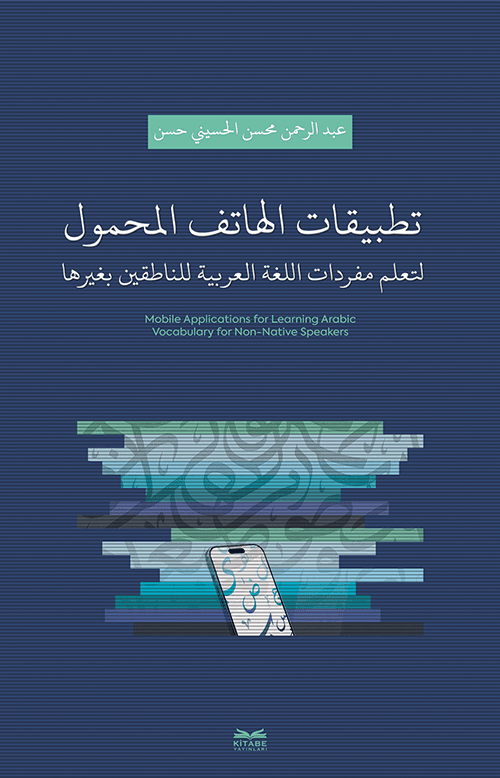
Mobile Applications for Learning Arabic Vocabulary as a Foreign Language
This book aims to facilitate and support the process of learning and improving the vocabulary of Arabic language learners through the design of a mobile application.
The book reviews previous research in Arabic and international literature, presenting studies focusing on the vocabulary of Arabic learners as a foreign language, along with learning strategies. It covers the definition of vocabulary, its selection criteria, and learning strategies in detail, as well as examining previous studies on mobile-assisted learning (MALL) and vocabulary learning apps.
As a result of these studies, effective vocabulary learning strategies for Arabic language learners were identified and mobile application design criteria were defined based on these strategies. An evaluation of some existing Arabic vocabulary learning applications against these criteria revealed their general weaknesses. A comprehensive mobile application design framework based on the ADDIE general instructional design model was proposed to overcome these weaknesses. The final chapter of the book offers suggestions and recommendations for future research and application.
Keywords: Mobile learning; Mobile application design; Vocabulary development; Vocabulary learning strategies; Non-native Arabic speakers.
Mobile Applications for Learning Arabic Vocabulary for Non‑Native Speakers
This book seeks to facilitate and enhance the acquisition and development of Arabic vocabulary among non‑native speakers through the design of a mobile application.
First, it reviews a range of Arabic and international studies that address vocabulary learning and associated strategies in Arabic‑as‑a‑foreign‑language contexts. It then examines the notion of vocabulary—its definition, the principles guiding item selection, and the strategies employed in its acquisition—and highlights empirical research on mobile‑assisted vocabulary learning and dedicated vocabulary‑learning applications.
Next, the book explores mobile learning more broadly, detailing its conceptual underpinnings, historical evolution, defining characteristics, and pedagogical benefits. It outlines the standards for designing effective educational and language‑learning applications, describes the stages involved in their development, and underscores the role of strategic vocabulary‑learning approaches when implemented via mobile platforms.
On this basis, the author derives a set of optimal vocabulary‑learning strategies tailored to non‑native Arabic learners and establishes design criteria for a mobile application aimed at fostering their lexical growth. Applying these criteria, several existing Arabic‑vocabulary learning apps are evaluated, revealing overall deficiencies. Ultimately, the book proposes a comprehensive design framework—grounded in the ADDIE instructional‑design model—for a novel mobile application to support targeted vocabulary development. The volume concludes with actionable recommendations and suggestions for future research and practice.
Keywords: Mobile learning; Mobile application design; Vocabulary development; Vocabulary‑learning strategies; Learners of Arabic as a foreign language.