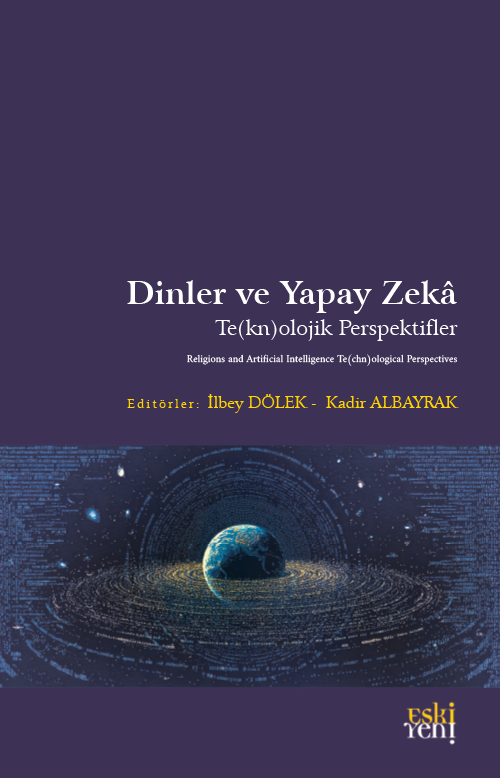
Religions and Artificial Intelligence
Te(chn)ological Perspectives
Religions and Artificial Intelligence: Te(chn)ological Perspectives is a
comprehensive study that explores the intersection of religious thought
and artificial intelligence technologies. By examining the theological
and ethical approaches developed within various religious traditions,
the book seeks to offer original contributions to both religious studies
and the field of technology. The first part analyzes how artificial intelligence
can represent both a “threat” and an “opportunity” to religious
traditions. This section includes discussions on methodological limitations,
data ethics, algorithmic bias, and the hermeneutical challenges
that arise in AI-assisted research in religious studies. The second part
focuses on debates surrounding artificial intelligence within Eastern
religions. It addresses topics such as the ontological and practical dimensions
of technology in Hinduism, the relationship between consciousness,
mind, and artificial intelligence in Buddhism, robotic rituals
and ethical frameworks in Chinese religions, and the interplay between
technology and the sacred in Japanese religious traditions. This section
offers an in-depth examination of East Asia’s historical and cultural
openness to technological innovation. The third part examines the idea
of artificial intelligence in semitic religions. It analyzes the connection
between the Golem tradition in Judaism and contemporary digital creations,
the anthropological and theological reflections on artificial intelligence
within Christian thought, and the debates on ethics, law, and
responsibility in Islam.
Keywords: Religion; God; Technology; Artificial intelligence; Ethics

 İÇ SAYFALAR