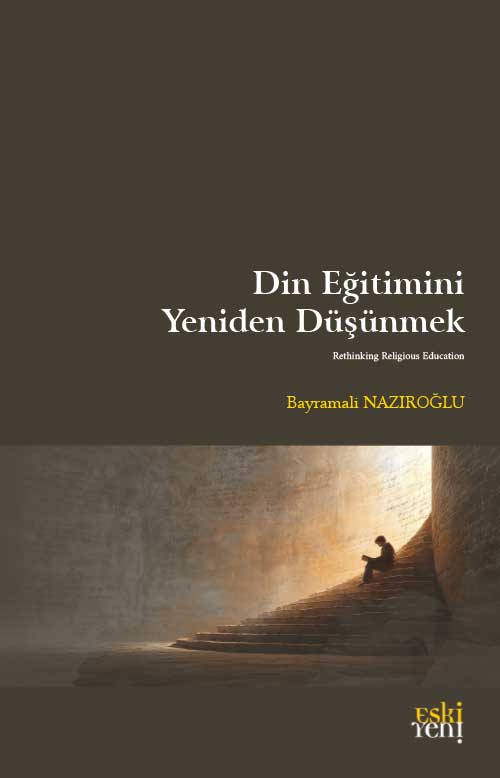
Rethinking Religious Education
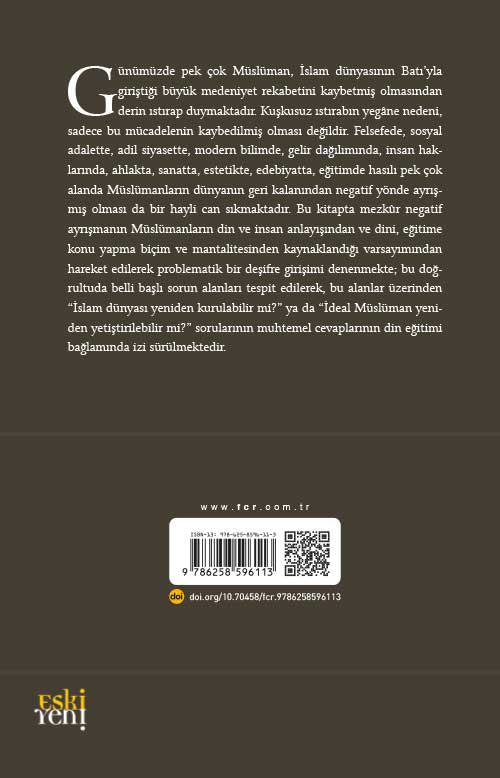
It is a fact that, over the past few centuries, the Islamic world has remained
relatively weaker than Western-centered states and societies in
political, economic, diplomatic, military, and social domains. Undoubtedly,
many interrelated reasons can be cited for this situation. However,
focusing on the meanings attributed to reason and science in these
two different worlds, and on how these meanings shape approaches to
human development, provides a valuable starting point for identifying
the core problems. The primary aim of this book is to explore this possibility.
The book proceeds from the assumption that the Islamic world is in
need of a shift in mindset in general education—and particularly in
religious education—and offers an essay-style discussion of a range of
issues that hinder the progress of Muslims. In this context, drawing
largely on developments in Turkey, it examines the inadequacies of
certain entrenched ideas, assumptions, and practices, and argues that
a new approach to religious education is possible in several key areas.
Apart from the preface and conclusion, the book consists of twelve
chapters. The main motivation behind the work is discussed under the
title “Confronting the Problem” while the chapter “Thinking” argues
for the realistic incorporation of diverse modes of reasoning into the
agenda of religious education. The chapter titled “Obedience” critiques
the ways in which religious education reinforces a culture of obedience,
and “Morality” examines the practical ethical problems faced by Muslims.
In the chapter “Autonomy” the emphasis is placed on the need
for the Muslim individual to be relatively autonomous and strong, both
in daily life and in matters of belief. In contrast, “Scientificity” questions
the existing distant attitude toward reason and science. The chapter
“Individual” highlights the importance of the individual and their
uniqueness, as opposed to approaches that prioritize society over the
person. “Social Justice” addresses how concepts such as justice, rights,
and equality are reflected in understandings of religious education. The
chapter “Human” discusses the importance of safeguarding human digviii
nity, while “Hatred” draws attention to the dangers of a form of discourse
among Muslims that easily spreads and tends to generalize evil.
Under the title “Merit” the book emphasizes the importance of appointing
qualified individuals and preventing favoritism in both religious
and societal contexts for the sake of development. Finally, the chapter
“War” traces the intellectual responsibilities that religious education
should assume in fostering a peace-oriented society.
Keywords: Religious education; Moral education; Religious education
approach; Thinking; Scientificity

 İÇ SAYFALAR