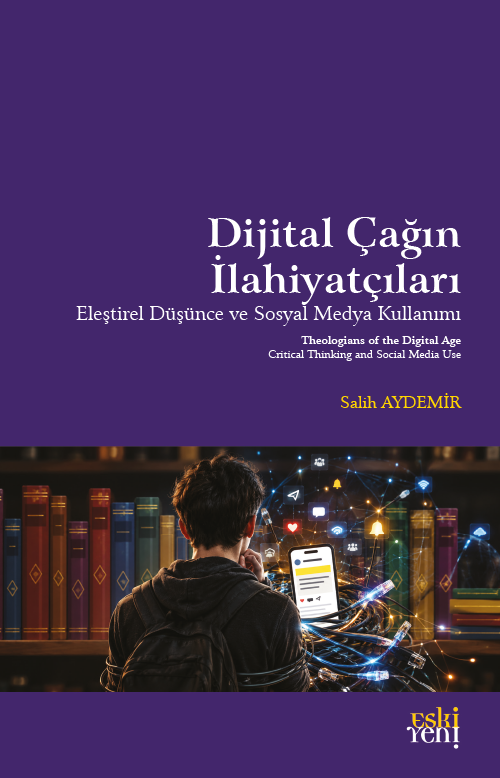
Theologians of the Digital Age
Critical Thinking and Social Media Use
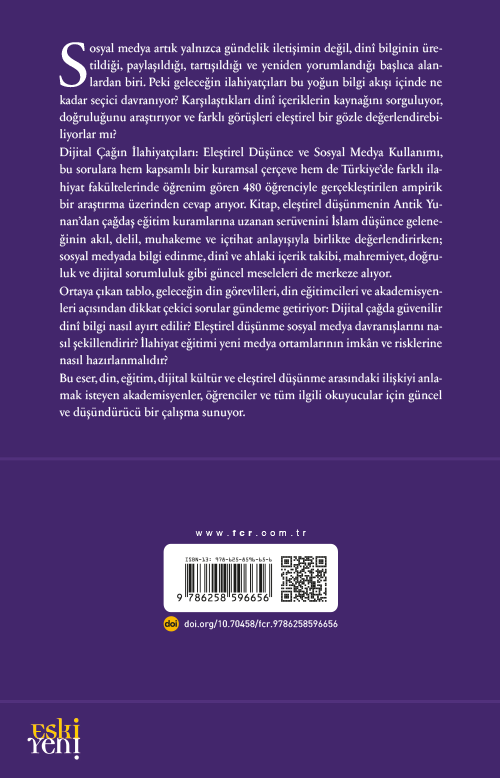
This study examines the effects of digitalization on the production, circulation,
and consumption of religious knowledge through the social
media practices and critical thinking dispositions of theology students.
The theoretical section traces the historical and conceptual development
of critical thinking from Socrates, Plato, and Aristotle to Dewey,
Ennis, Facione, Paul and Elder, and Halpern, while also comparing these
approaches with traditions of reasoning, evidence, inference, analogy,
ijtihad, and verification in Islamic thought. The empirical section
adopts a quantitative, correlational survey design with a cross-sectional
and descriptive framework. Data were collected through an online
questionnaire from 480 undergraduate students enrolled in theology
faculties at different universities in Türkiye. Critical thinking dispositions
were measured using the Marmara Critical Thinking Dispositions
Scale. The data were analyzed through descriptive statistics, independent-
samples t-tests, one-way ANOVA, Pearson correlation, and multiple
linear regression. Findings indicate that students generally display high
levels of critical thinking disposition and use social media primarily for
obtaining information, following news, communication, education, and
professional development. Higher critical thinking scores are associated
with greater use of social media for information seeking, educational
purposes, and following religious-moral content, as well as stronger
concern for accuracy, privacy, and social-moral appropriateness in
sharing practices. Significant gender differences were found in favor
of female students, whereas class level did not produce a significant
difference in overall critical thinking scores. The study concludes that
theology education in the digital age should integrate critical thinking,
media literacy, digital ethics, and the responsible production and evaluation
of reliable religious knowledge.
Keywords: Critical Thinking; Social Media; Theology Students; Digital
Religion; Media Literacy

 İÇ SAYFALAR