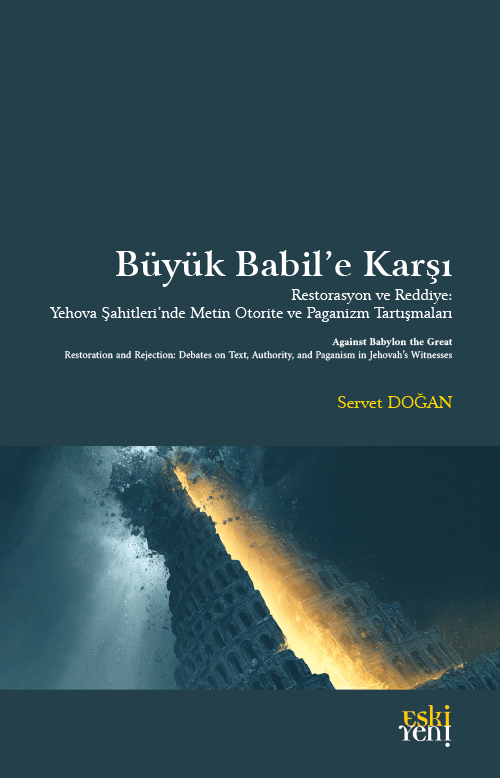
Against Babylon the Great
Restoration and Rejection: Debates on Text, Authority, and
Paganism in Jehovah’s Witnesses
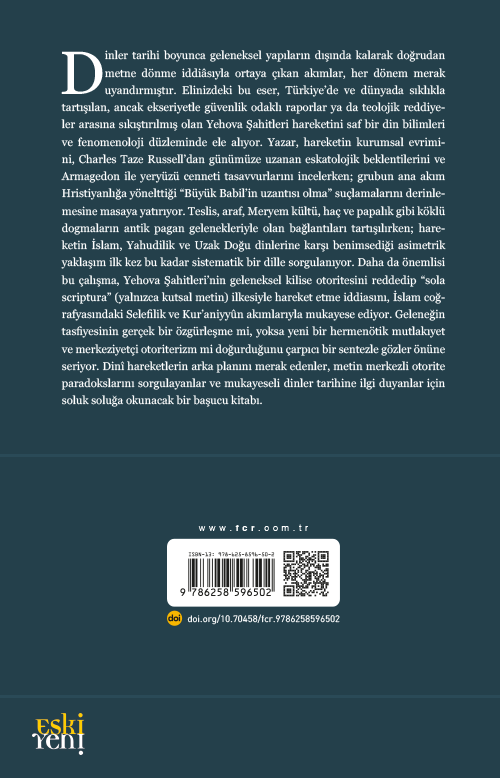
This book is a comprehensive academic study that analyzes the Jehovah’s
Witnesses movement from an entirely objective and phenomenological
perspective of the comparative history of religions, completely
independent of security-focused forensic reporting or apologetic theological
concerns. The research thoroughly examines the theological
infrastructure of the group founded by Charles Taze Russell, focusing
on their Christology, Armageddon eschatology, belief in post-mortem
unconsciousness, and their radical doctrinal critiques directed at institutional
Christianity. Jehovah’s Witnesses characterize mainstream
Christian forms (Catholic, Orthodox, and Protestant) as “Babylon the
Great.” They argue that fundamental church dogmas such as the Trinity,
purgatory, the cult of the Virgin Mary, the veneration of the cross,
clerical celibacy, confession, and the institution of the papacy are demonic,
pagan additions that infiltrated from ancient Mesopotamia and
Babylonian paganism.
The most original and interdisciplinary contribution this work offers
to the literature is its comparative evaluation of the movement’s claim
to reject historical tradition and return directly to the sacred text (sola
scriptura) alongside Salafism and Quranism movements in the Islamic
world. The study sociologically demonstrates how this anti-formalist
structure, which rejects church hierarchy and historical accumulation
as corruption, fails to provide dogmatic liberation. Instead, it builds
a much stricter, exclusionary, and centralized hermeneutical (interpretive)
monopoly around its own Governing Body. Furthermore, the
movement’s asymmetrical critique methodology towards other religions
is highlighted. It is documented that Jehovah’s Witnesses direct
all their polemical energy towards Christian orthodoxy, whereas they
categorize belief systems like Islam, Judaism, Hinduism, Taoism, Shintoism,
and Buddhism directly as extensions of “Babylon the Great” and
demonic constructs manipulating the masses, without subjecting them
to deep philosophical scrutiny. Ultimately, this independent book sucvi
cessfully deconstructs the theology, paganism rhetoric, and institutional
authority building of Jehovah’s Witnesses based on text monopoly within
an impartial academic framework
Keywords: Jehovah’s Witnesses; Comparative History of Religions; New
Religious Movements; Paganism Critique; Text-Centrism

 İÇ SAYFALAR