New Approaches in Arabic Linguistics
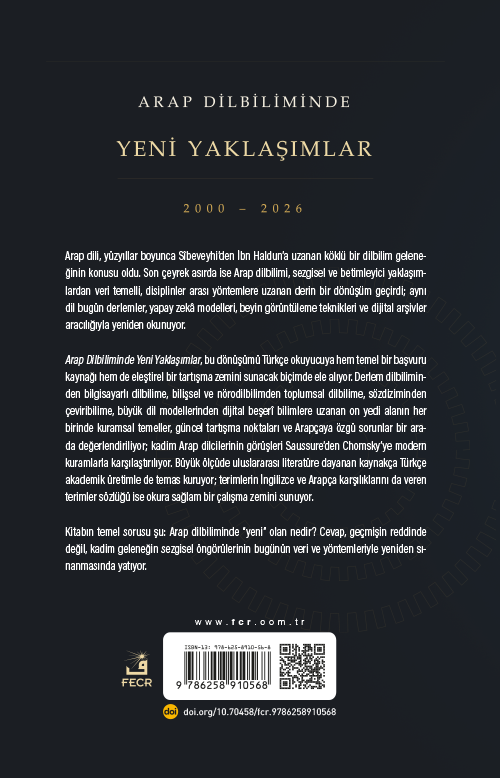
This book examines the methodological transformation that Arabic
linguistics has undergone over the last quarter century, moving from
intuitive and descriptive approaches towards data-driven and interdisciplinary
methods. After an introduction that surveys the classical Arabic
linguistic tradition, the rise of modern linguistics, Orientalist contributions
and the institutional role of the Arabic language academies,
seventeen chapters address seventeen subfields: corpus linguistics, computational
linguistics and natural language processing, cognitive linguistics,
neurolinguistics, sociolinguistics, pragmatics and discourse studies,
historical and comparative linguistics, applied linguistics and language
teaching, phonology, lexicography, lexicology, semantics, theoretical syntax,
translation studies, large language models, digital humanities, and
the comparison of classical Arabic linguistics with modern linguistics.
Each chapter brings together the theoretical foundations of the field,
problems specific to Arabic -such as root-and-pattern morphology, unvocalized
script, diglossia and dialectal diversity- and current international
research. By comparing the views of classical scholars such as Sībawayh,
ʿAbd al-Qāhir al-Jurjānī, al-Zamakhsharī, Ibn Jinnī and Ibn Khaldūn with
those of modern theorists such as Saussure, Firth, Austin, Searle and
Chomsky, the book argues that what is “new” in Arabic linguistics is often
that principles intuitively anticipated by the classical tradition can
now be tested with big data, computation and artificial intelligence. The
conclusion discusses the gaps in the field, including its uneven development,
the scarcity of dialectal data and the need for diachronic corpora,
and sets out an agenda for future research. The book is supplemented by
a comprehensive glossary that also gives English and Arabic equivalents
of the terms and by an extensive bibliography. It is intended both as a
reference work and as a gateway to advanced debate for students, researchers
and newcomers to Arabic language and linguistics.
Keywords: Arabic Linguistics; Corpus Linguistics; Natural Language
Processing; Cognitive Linguistics; Sociolinguistics; Large Language Models;
Digital Humanities; Classical Arabic Linguistics


 İÇ SAYFALAR


