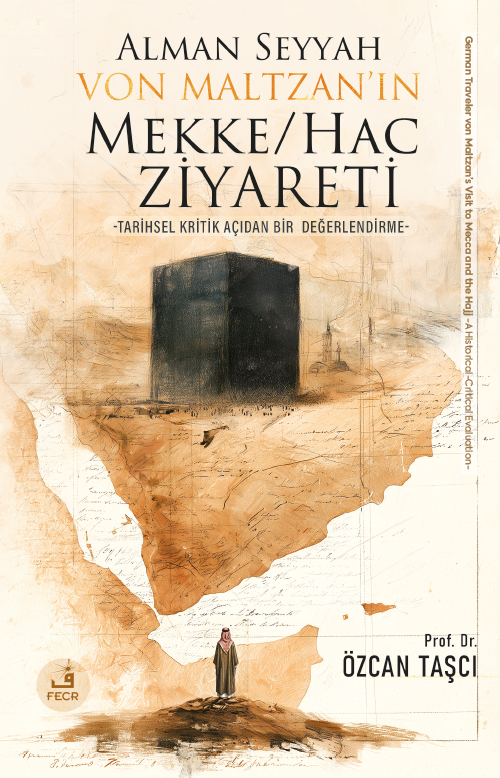
German Traveler von Maltzan’s Visit to Mecca and the Hajj
-A Historical-Critical Evaluation-
This study examines, from a historical-critical perspective, the visit to Mecca and the Hajj that the German traveler Heinrich Freiherr von Maltzan claimed to have undertaken in the nineteenth century. It first discusses Western travelers who visited Mecca before Maltzan for various purposes and then analyzes Maltzan’s journey, during which he assumed a Muslim identity, with particular attention to his itinerary and observations. His route through Alexandria, Cairo, the Nile Valley, Qina, Qusayr, Yanbu, Jeddah, and Mecca provides the framework for examining the social, cultural, religious, and ethnographic dimensions of the pilgrimage. Particular attention is given to Maltzan’s descriptions of the Kaʿba, al-Masjid al-Haram, the Black Stone, Zamzam, circumambulation, saʿy, ʿArafat, Muzdalifa, and Mina. A central issue addressed in the study is the authenticity of Maltzan’s pilgrimage narrative. In this context, Ulrike Freitag’s research, inconsistencies in Maltzan’s account, and the question of historical verification are critically assessed. The study further analyzes Maltzan’s historical-critical and intuitive approach to religious traditions as well as his Eurocentric, Orientalist, and occasionally prejudiced judgments. Finally, Western interest in the Hajj and the Holy Cities is discussed within the broader framework of colonialism and applied Orientalism, particularly through the example of Christian Snouck Hurgronje.
Keywords: Heinrich Freiherr von Maltzan; Hajj; Mecca; Historical-Critical Method; Orientalism

 İÇ SAYFALAR