Ways of Reasoning
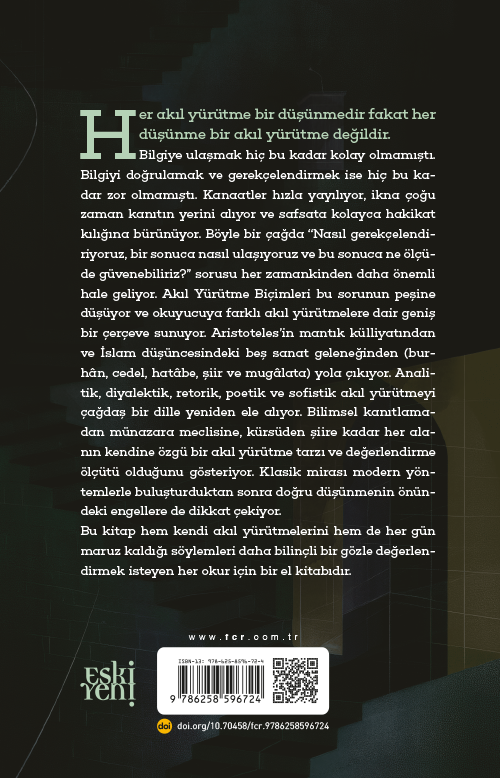
Although they are often used interchangeably in everyday language,
thinking and reasoning are not the same thing. Thinking is the mind’s
broadest and most comprehensive activity. Reasoning, by contrast, is a
justified transition from the known to the unknown, or from accepted
premises to a conclusion, and is therefore more amenable to scrutiny
than thinking in general. Ways of Reasoning focuses on this narrower
and more disciplined domain as a continuation of and complement to
the previously published volume Ways of Thinking. The work takes its
point of departure from Aristotle’s logical corpus and from the interpretation
of this corpus in the Islamic logical tradition, particularly the
tradition of the “five arts.” Burhān, jadal, khiṭābah, shiʿr, and mughālaṭah
are reconsidered in contemporary terms under the headings of
analytical, dialectical, rhetorical, poetical, and sophistical reasoning,
respectively. The book opens with the chapter “An Introduction to Reasoning,”
builds a bridge from the classical framework to contemporary
debates through “A View of Modern Reasoning,” and concludes with
“Obstacles to Reasoning.” Although the chapters are written by different
authors, they are based on a common framework. Each chapter
examines the sources and foundations of the way of reasoning under
consideration, the features that distinguish it from other ways, the way
in which its method is justified, its manifestations in both historical and
contemporary contexts, and the criteria by which it should be evaluated.
In an age in which persuasion often takes the place of evidence, this
book aims to serve as a handbook that enables readers to evaluate both
their own reasoning and the discourses to which they are exposed with
greater awareness and critical attention.
Keywords: Logic; Reasoning; Epistemology; Argumentation; Critical
Thinking.

 İÇ SAYFALAR