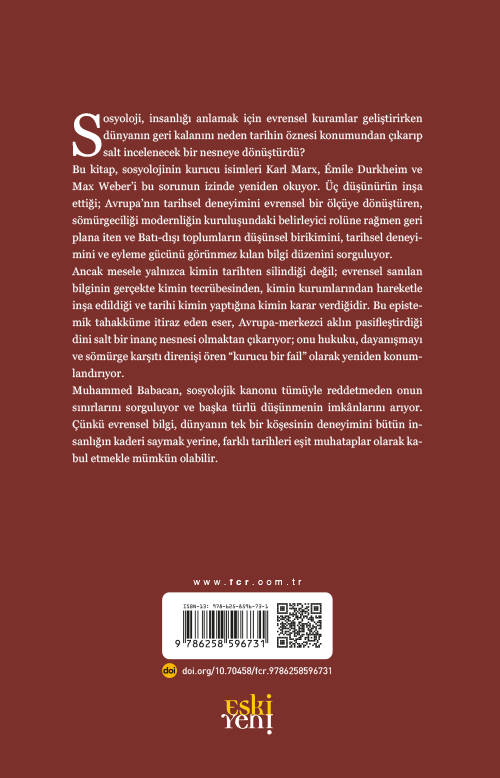
Classical sociology arrived upon the historical stage professing to construct
universal laws, yet in doing so it consigned to the margins of
theory the very imperial conditions that rendered its own existence
possible, together with the non-Western subject. This study contends
that such exclusion amounts not to a mere methodological oversight
but to an ontological dispossession and a form of epistemic violence —
one that effaces the historical memory, the intellectual agency and the
world-making capacity of the “Other”. At its centre stand Karl Marx,
Émile Durkheim and Max Weber, the figures who together constitute
the founding canon of the discipline. However divergent their theoretical
orientations, the book argues, the three thinkers share a common
“Protestant/secular unconscious”, and it is in their treatment of
religion above all that their Eurocentric presuppositions are brought
most sharply into view. The canon, in short, pacified the very object it
set out to study, imposing upon religion the historically secular conceptual
limits of its own making. This epistemic violence assumes three
distinct guises across the founding texts. Religion is reduced, in Marx,
to a reflex of the economic base; in Durkheim, to a social invention that
modulates into the moral authority of the nation-state; and, in Weber,
to an ontological deficiency measured against the yardstick of Western
rationality. Presented as though it were a universal norm, this categorial
narrowing produced what might be termed a violence of translation
in its account of non-Western social formations, equating faith with the
passive outcome of material conditions. Against such Eurocentric reductionism,
the book reconceives religion as a “constitutive agent” and
a “map of meaning” — one that shapes law, institutional solidarity and
resistance within non-Western contexts. Drawing upon the resources of
postcolonial and decolonial critique, and deploying such instruments
as “epistemic disobedience” and a “sociology of absences”, the study
seeks to come to terms with the canon on new ground. Its ultimate aim
is to divest the sociological imagination of its colonial unconscious and
to take the first steps towards a pluriversal sociology of religion — one
that admits divergent traditions of knowledge as equal interlocutors in
the conversation.
Keywords: Sociology of religion; Karl Marx; Émile Durkheim; Max Weber;
sociological canon; postcolonial theory; decolonial critique; ontological
expropriation; colonial unconscious; epistemic violence; pluriversal
sociology.


 İÇ SAYFALAR


