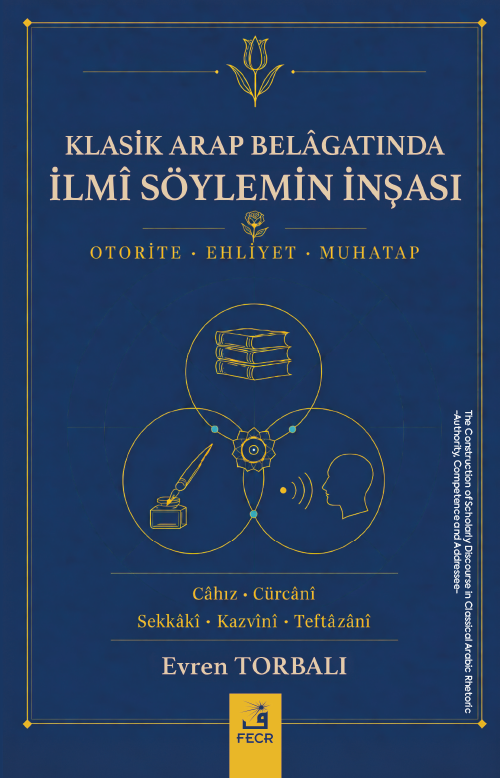
The Construction of Scholarly Discourse in Classical Arabic Rhetoric:
Authority, Competence and Addressee
Classical Arabic rhetorical texts do more than transmit technical terms,
rules, and rhetorical devices; they also reveal how scholarly discourse
is legitimized, who is considered qualified to make judgments, and how
the addressee is positioned within knowledge production. This study
examines these issues through the axes of authority, competence, and
addressee by comparatively analyzing al-Jāḥiẓ’s al-Bayān wa-l-tabyīn,
ʿAbd al-Qāhir al-Jurjānī’s Dalāʾil al-iʿjāz, al-Sakkākī’s Miftāḥ al-ʿulūm, al-
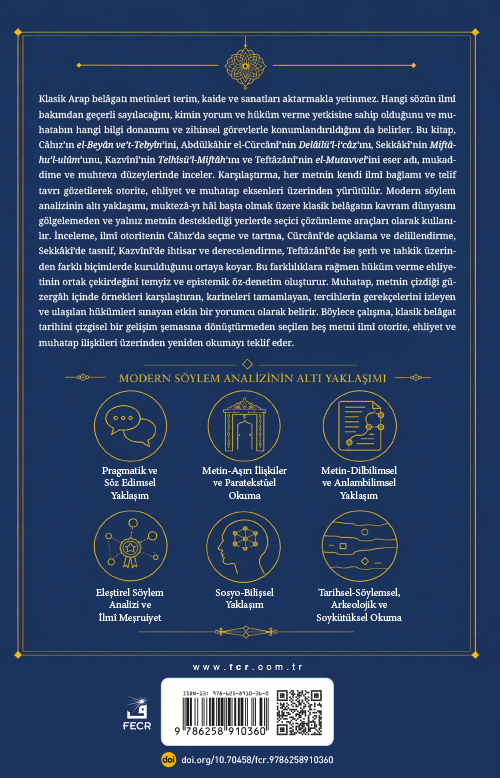
Qazwīnī’s Talkhīṣ al-Miftāḥ, and al-Taftāzānī’s al-Muṭawwal. The approaches
employed are pragmatic and speech-act analysis, transtextual relations
and paratextual reading, text-linguistic and semantic analysis,
critical discourse analysis and scholarly legitimacy, the socio-cognitive
approach, and discourse-historical, archaeological, and genealogical
reading. They are applied selectively and in a text-centered manner,
with attention to the conceptual resources of the classical tradition,
especially muqtadā al-ḥāl. The findings show that scholarly authority
takes different forms in each author. In al-Jāḥiẓ, it emerges through selecting,
assessing, and presenting a network of testimony and transmission;
in al-Jurjānī, through explaining and substantiating judgments;
in al-Sakkākī, through definition, division, and arrangement; in al-
Qazwīnī, through abridgment, grading opinions, and testing the scope
of definitions; and in al-Taftāzānī, through commentary, verification of
sources and transmission, assessment of evidence, and revision when
necessary. Across all five texts, discernment and epistemic self-regulation
form the shared core of competence. The addressee appears as
an active epistemic subject who compares examples, reconstructs contextual
clues, follows the reasons for preferences, and tests judgments.
The study further shows that scholarly innovation develops through
explanation, selection, rearrangement, correction, abridgment, and
commentary while maintaining continuity with earlier sources. It also
demonstrates that the six approaches help reveal forms of authority,
criteria of competence, and conceptions of the addressee. Thus, a discourse-
analytical reading grounded in classical Arabic rhetoric proves
applicable and allows textual transmission to be traced without resorting
to a linear model of progress.
Keywords: Arabic Language and Rhetoric; Scholarly Discourse; Discourse
Analysis; Authority; Competence; Addressee

 İÇ SAYFALAR