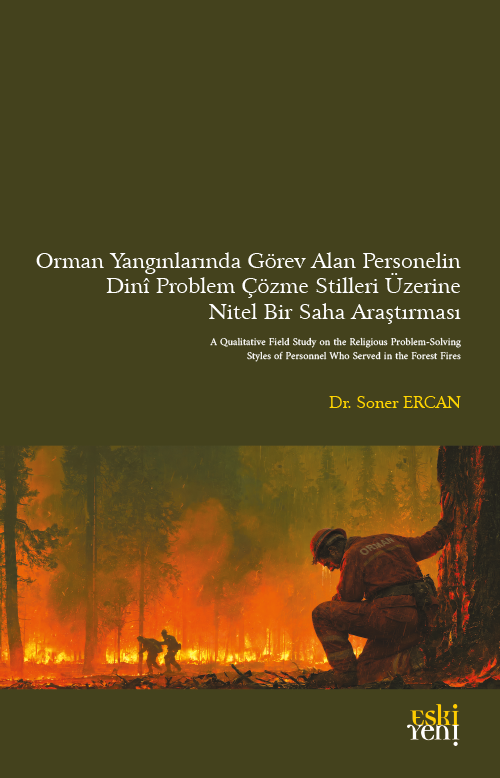
A Qualitative Field Study on the Religious Problem-Solving Styles
of Personnel Who Served in the Forest Fires
The aim of this study is to explore in depth, through a qualitative approach
and with phenomenological sensitivity, how personnel of the
General Directorate of Forestry (Orman Genel Müdürlüğü, OGM) and
fire-service who served in the forest fires that have occurred in Türkiye
experience their religious problem-solving styles. Beyond this, it
seeks to examine the role of religion in how these OGM and fire-service
personnel make sense of what they lived through during the forest fires.
This study aims to contribute to future research by examining how
members of an occupational group engaged in life-threatening duties
employ religious coping styles when confronted with fatal life events,
as well as how they relate these experiences to religious concepts, including
patience (sabr), reliance on God (tawakkul), fate (qadar), and
gratitude (shukr). The study’s central research question is: “How do
personnel who served in forest fires experience their religious problem-
solving styles, and how do they make sense of this experience?”
The study group was constituted through criterion sampling, a purposive
sampling technique, and comprises General Directorate of Forestry
and fire-service personnel who actively served in the forest fires that
occurred in Türkiye in 2021 and in subsequent years. It consists of 31
participants with a mean age of 40.1. The semi-structured interviews
conducted with the participants showed that the findings took shape
around nine themes. The findings indicate that participants understood
their faith as a source of courage and turned to God in situations where
they experienced helplessness. They framed the forest fires within
notions of fate (kader), divine decree (takdir-i İlâhi), and divine trial
(imtihan), as well as human error and negligence; while responding to
the fires, they fulfilled their own responsibilities and left the outcome
to God. Throughout the process, the self-directing style was not used
consistently, whereas the deferring, collaborative, and surrender styles
were employed, with participants shifting between styles according to
the situation at hand. In the participants’ accounts, a pattern of responsibility
and meaning-making grounded in the Islamic understanding
of trust (emanet), deputyship (vekâlet), and vicegerency (halifelik) was
identified. Narratives centered on sacred trust, vicegerency, responsibility,
and safeguarding God’s dominion may signal that this pattern is
attuned to its religious-cultural context.
Keywords: Psychology of Religion; Religious Problem-Solving Styles;
Disaster; Forest; Fire

 İÇ SAYFALAR